
In-Play NFL Live Betting: Strategies and Odds
 Available in US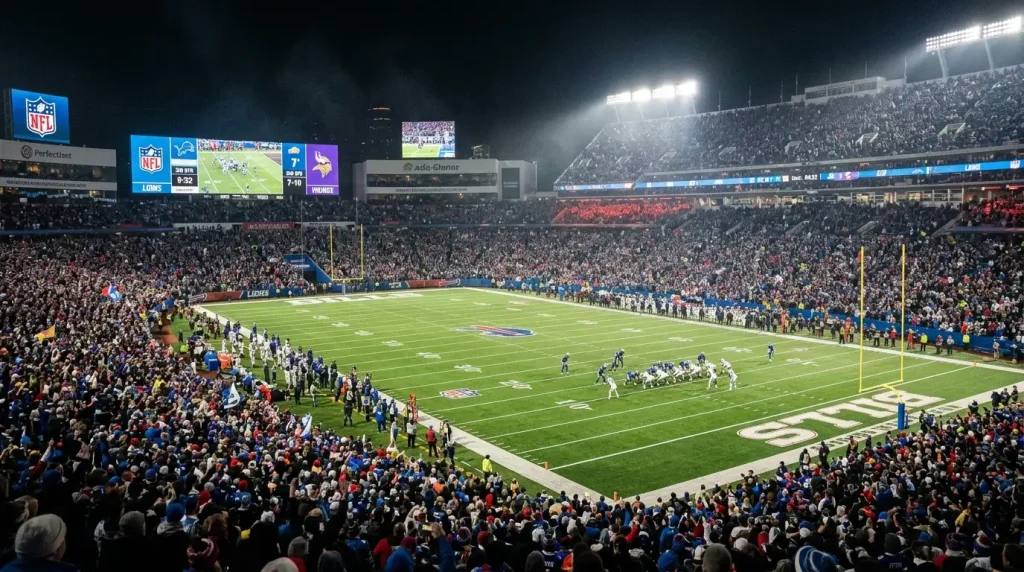
NFL In-Play Betting: Exploiting Live Odds and Game Momentum
The most profitable NFL bet I placed last season wasn’t before kick-off. It was seven minutes into the third quarter of a Thursday night game, when a team that had been down 17-3 at half-time scored on their opening drive of the second half and the live spread suddenly offered a number I’d have taken before the game even started. I got +3.5 on a side that opened at +2.5 pre-match, and they covered by a comfortable margin. That kind of opportunity only exists in-play.
NFL live betting rewards punters who prepare. Unlike football — where the ball spends long stretches in midfield and the momentum narrative is gradual — American football is structured around discrete possessions, scoring drives, turnovers and clock management. Each of those events creates a sharp, quantifiable shift in win probability, and sportsbooks must reprice their markets in response. If you understand the game’s rhythm better than the algorithm adjusting the odds, you have an edge.
UK sportsbooks now process over 290 million online bets on real-world events every month. A growing share of that volume is in-play, and NFL represents one of the most dynamic live betting environments available. The game’s built-in stoppages — between plays, during timeouts, at quarter breaks — give you time to think, which is a luxury you rarely get in other live markets. This isn’t about reacting faster than a computer. It’s about reading context that computers struggle with.
Over eleven years of covering NFL markets, I’ve watched live betting evolve from a niche offering at a handful of operators to a core product at virtually every UK-licensed sportsbook. The tools have improved, the market depth has grown and the pricing has become sharper. That last point matters — sharper pricing means the easy live edges from five years ago have closed. What remains are the edges that require genuine game knowledge, preparation and discipline. Those are the edges I’ll walk you through here.
How NFL Live Betting Works: Mechanics and Market Flow
Before I break down tactics, you need to understand the machinery behind live NFL markets. It’s different from what you might be used to in Premier League in-play.
NFL live odds are primarily driven by win-probability models. These models calculate, in real time, each team’s likelihood of winning based on the current score, time remaining, field position, down and distance, and the pre-game spread. Every play shifts these variables. A 40-yard completion moves the win probability; a fumble reverses it. The sportsbook’s algorithm recalculates and adjusts the live spread, live moneyline and live total after every significant event.
The online segment accounts for 67.5% of the global sports betting market, and within that segment, live markets have grown faster than pre-match in every major sport. NFL is particularly well-suited because the game has natural pauses. Between plays, the offence has 40 seconds on the play clock. During that window, the sportsbook’s live markets are typically open for betting. They close briefly during the play itself, then reopen once the outcome is settled. Timeouts, two-minute warnings and quarter breaks create longer windows where you can assess and act without time pressure.
At UK sportsbooks, NFL live markets generally include the adjusted spread (which moves from the pre-game number based on the current score), the live moneyline (updated win probability for each side), the live total (adjusted based on scoring pace), and several micro-markets like next team to score, next scoring method and drive result. The depth varies by operator — some offer 20+ live markets per game, others stick to the core three.
One mechanical detail worth noting: live odds often carry a wider margin than pre-match. Pre-match NFL spreads typically sit at 1.91 on both sides (a 4.5% margin). Live spreads can push to 1.83-1.87 per side, reflecting the sportsbook’s increased uncertainty and the premium they charge for real-time pricing. This means you need a slightly larger edge to break even on live bets compared to pre-match. It’s the cost of the opportunity, and it’s worth paying when the opportunity is genuine.
Quarter-by-Quarter Tactics: When to Strike
I’ve tracked my own live betting performance by quarter for the last four seasons, and the results consistently point in one direction: the best value windows cluster around half-time and the end of the third quarter. The worst time to bet live is the opening ten minutes, when the market is still anchored to pre-game pricing and hasn’t absorbed enough game-specific information to deviate meaningfully.
The first quarter is deceptive. Scores are low, possessions are limited and a single turnover can swing the live spread by 3+ points in a direction that feels dramatic but is statistically meaningless. Teams run scripted opening drives — the first 15-20 offensive plays are rehearsed all week — so early success doesn’t necessarily reflect a team’s true level for the remaining three quarters. I generally watch the first quarter without touching the live markets.
Half-time is where things get interesting. NFL coaches make significant adjustments between halves. If a defensive scheme that worked brilliantly in the first half relied on disguised coverages, the opposing offensive coordinator has had 20 minutes to identify and counter it. If a team abandoned the run game early due to falling behind, half-time adjustments might restore balance. The NFL’s average viewership hit 18.7 million per game in the 2025 season — a figure driven partly by the second-half drama that makes these adjustments visible to anyone watching closely.
The specific window I target is the first five minutes after half-time. If a trailing team scores on their opening second-half drive, the live spread hasn’t fully adjusted to the momentum shift because the algorithm needs multiple data points to recalibrate. You’re getting a number that still reflects some of the first-half deficit, even though the game dynamics have shifted. Conversely, if the trailing team goes three-and-out to start the second half, the live spread often overcorrects, creating value on that same trailing team at an inflated number.
Late third quarter and early fourth quarter is the second prime window. By this point, you’ve seen 35-40 minutes of game action. Scripted plays are long exhausted. Fatigue is a factor. Teams trailing by 10+ points start shifting to pass-heavy, no-huddle offences that either compress the score quickly or lead to turnovers. Both outcomes create sharp, short-lived mispricings in the live spread. If you’ve done your pre-game homework on each team’s fourth-quarter tendencies — how they protect leads, how they chase deficits — you can anticipate these shifts before the algorithm prices them in.
The final two minutes of either half are generally poor betting windows. Markets are thin, margins are wide, and outcomes hinge on clock management decisions that are nearly impossible to predict. I treat the two-minute warning as my cue to stop betting and start watching.
Reading Momentum Shifts in Real Time
Momentum in NFL is real, but not in the way casual viewers think. A team scoring three consecutive touchdowns hasn’t necessarily unlocked some mystical force — they may have benefited from a short field after turnovers, or faced a defence that was already thin at cornerback due to injury. The live betting algorithm captures the scoring. Your job is to assess whether the scoring reflects a sustainable shift or a sequence of events unlikely to repeat.
I look for three signals when assessing momentum. The first is possession time. A team dominating time of possession is wearing down the opposing defence, and that effect compounds as the game progresses. If one side has held the ball for 22 of the first 30 minutes, the other team’s defence is fatigued in ways that don’t show up on the scoreboard yet but will in the fourth quarter. This is where watching the game — not just checking the score on your phone — gives you an advantage the algorithm doesn’t have.
The second signal is turnover margin. Turnovers are high-variance events — a tipped pass that becomes an interception, a fumble on a routine handoff. They dramatically shift win probability models, which means they dramatically shift live odds. But turnovers don’t sustain. A team that has thrown two interceptions in the first half is not twice as likely to throw interceptions in the second half. If the live spread has moved 7+ points because of turnovers, and the underlying play quality (yards per play, success rate on early downs) tells a different story, the live number is mispriced.
Joey Feazel from Caesars Sportsbook illustrated this principle when discussing how the market overestimated the impact of the Lions losing their coordinators before the 2025 season. The same logic applies within games: the market overreacts to dramatic events and underreacts to grinding, less visible advantages. Your edge as a live bettor is recognising which category the current momentum falls into.
The third signal is personnel changes. If a starting quarterback gets injured in the second quarter and the backup enters, the live spread will move sharply. But I’ve seen cases where the backup was a mobile quarterback replacing a pocket passer, and the offensive scheme that had been sputtering suddenly found rhythm because the defence wasn’t prepared for scrambling. The algorithm knows the backup is statistically worse. It doesn’t always know that the specific matchup favours the backup’s skill set. That’s context you can only get from watching the game.
Live Market Types: Next Score, Drive Result, Adjusted Spreads
Most UK punters default to the live spread or live moneyline and ignore the micro-markets entirely. That’s a mistake, because the smaller markets are often where sportsbooks are least efficient.
The “next team to score” market is straightforward — you’re backing which side puts points on the board next. It resets after every scoring play. The edge here comes from understanding field position and game situation. If one team just punted from their own 15-yard line and the other takes over at midfield, the team receiving the ball has a significantly higher probability of scoring next. The live odds reflect this, but they don’t always account for defensive fatigue, wind direction or the specific red-zone tendencies of the offence about to drive.
Drive-result markets — available at the more sophisticated UK operators — let you bet on the outcome of the current offensive possession: touchdown, field goal, punt, turnover or end of half. These are short-duration bets that resolve within minutes. I find the most value in “punt” and “field goal” outcomes when a team crosses midfield but faces a strong red-zone defence. The market tends to overweight touchdown probability once a team enters opponent territory.
Adjusted live spreads are simply the pre-game spread recalculated for the current score and time remaining. With $30 billion in legal NFL bets placed in the 2025 US season alone — the vast majority on spread and total markets — these are the most liquid live markets and the hardest to beat. But they’re also the most useful when the game flow has created a specific situation your pre-game analysis anticipated. If you identified a team as a strong second-half performer before kick-off and they trail by 10 at half-time, the adjusted live spread is your entry point.
Live totals deserve a separate mention. The pre-game total — the combined score the sportsbook expects — adjusts throughout the game based on actual scoring pace. If a game is 21-17 at half-time and the pre-game total was 44.5, the live total for the remainder will reflect the elevated scoring rate. But here’s the nuance: NFL scoring is not linear. High-scoring first halves often produce lower-scoring second halves as trailing teams shift to run-heavy clock management or leading teams adopt conservative play-calling. Conversely, a 6-3 half-time score doesn’t mean the game will finish 12-6 — it often means the dam breaks in the third quarter once adjustments kick in. Understanding this non-linearity gives you an edge on live totals that purely mathematical models miss.
Next scoring method — field goal, touchdown, safety — is a novelty market that I rarely touch. The frequency of safeties is too low to model reliably, and the margin on these bets tends to be extortionate. Stick to the markets where you can build a genuine informational advantage.
Timing Your Live Bets Around UK Kick-off Windows
Living in the UK and betting NFL live means embracing some inconvenient hours. The standard Sunday schedule gives you three kick-off windows: 6pm GMT (the early slate of games), 9:05pm or 9:25pm GMT (the afternoon slate), and 1:20am Monday morning GMT (Sunday Night Football). Thursday Night Football kicks off at 1:15am Friday GMT, and Monday Night Football starts at 1:15am Tuesday GMT. If you want a deeper look at how these windows map to the full season, I’ve laid it all out in why first-half markets deserve attention.
The 6pm Sunday kick-off window is the most accessible for UK live bettors. You can watch from the sofa, track multiple games simultaneously and place live bets during what is still a reasonable evening hour. Seventy-six percent of UK punters aged 18-24 use mobile phones for betting, and the 6pm Sunday window suits mobile perfectly — you can follow along whether you’re at home, at a pub or commuting.
The late-night windows require commitment. I’ve found that the Thursday and Monday night single-game broadcasts actually suit live betting well because you’re focused entirely on one fixture. There’s no distraction from parallel games, and the broadcast coverage — replays, analysis, sideline reports — gives you more contextual information to work with. The trade-off is obvious: you’re betting at 2am on a weeknight. Amazon Prime Video’s Thursday Night Football averaged 15.33 million viewers in the 2025 season, up 16% from the prior year — proof that primetime NFL fixtures attract enormous engagement, which in turn ensures sportsbooks keep their live markets deep and liquid even during late UK hours.
One practical consideration: liquidity drops in UK live markets during the late games. Fewer UK punters are awake to bet, which means sportsbooks sometimes widen their margins or reduce market availability. If you’re serious about late-night live betting, check beforehand whether your operator keeps the full suite of live markets open for primetime fixtures. Some scale back to just the core three — spread, moneyline, total — after midnight.
Pitfalls of NFL In-Play Betting
I need to be blunt about the risks because I’ve watched disciplined pre-match bettors turn into reckless live punters within a single Sunday. The pace and excitement of live betting creates psychological traps that pre-match wagering doesn’t.
Chasing losses mid-game is the most destructive pattern. You back a team pre-match, they fall behind early and you double down on the live spread to recover. Now you’ve got double the exposure on a team that’s losing. If they come back, you feel like a genius. If they don’t, you’ve turned a one-unit loss into a two-unit catastrophe. Ten percent of the UK population participates in online sports betting — and for a proportion of those punters, live betting’s immediacy intensifies the impulse to chase.
Overtrading is the second pitfall. NFL games last over three hours. Every play generates a new data point, a new emotional reaction, a new betting opportunity. If you’re not careful, you’ll place ten live bets per game and erode any edge you had through accumulated margins. I cap myself at two live bets per game, maximum. If neither of my identified windows produces a clear opportunity, I don’t bet. That constraint feels limiting in the moment but protects your bankroll over a season.
The third pitfall is mistaking entertainment for analysis. Watching a game is fun. Betting live makes it more fun. But fun is not a strategy. I’ve seen punters bet on the next score because they’ve got a “feeling” — and feelings in NFL live betting are worth exactly nothing. If you can’t articulate your edge in one sentence before placing the bet, you don’t have one. In-play wagering requires a solid understanding of pre-game lines, especially how NFL spread betting shifts dynamically after every drive.
Your First NFL Live Betting Sunday: A Practical Plan
If you’re new to NFL live betting, here’s what I’d suggest for your first Sunday. Pick one game from the 6pm slate — ideally one you’ve analysed pre-match. Watch the first quarter without betting. At half-time, review what you’ve seen against your pre-game expectations. If the live spread offers a number that contradicts what the game flow is telling you, that’s your opportunity. Place one bet, at a stake consistent with your bankroll plan, and watch it play out. That single experience will teach you more about live NFL markets than any article can. To maximize your in-play profits, always cross-reference live odds with the data provided in our comprehensive UK NFL betting guide.
Is NFL live betting available at UK-licensed sportsbooks?
Yes. All major UK-licensed sportsbooks offer NFL live betting markets during games. Market depth varies by operator — some provide 20+ in-play options per game while others focus on core markets like the live spread, moneyline and total. Availability is consistent for Sunday and primetime fixtures.
Which NFL live markets offer the best value after half-time?
The adjusted live spread and live total tend to offer the most consistent value after half-time because they reflect half-time adjustments that algorithms are slow to price in. Drive-result markets can also be valuable if you have a strong read on second-half game flow and red-zone tendencies.
How quickly do NFL in-play odds change compared to football?
NFL odds update after every play, which happens roughly every 30-40 seconds during active possessions. Football in-play odds shift less frequently because continuous play produces fewer discrete, high-impact events. The stop-start nature of American football creates sharper, more frequent odds movements.
Can I cash out NFL live bets early?
Most UK-licensed sportsbooks offer cash-out functionality on NFL live bets, though availability depends on the specific market and game situation. Cash-out values are recalculated in real time based on current odds. Be aware that cash-out prices typically include an additional margin compared to placing a new opposing bet.
Articles
Published by the American Football Betting Online team.
