
UK American Football Betting: NFL Odds and Sportsbooks
 Available in US
Data-driven NFL analysis for the UK punter

American Football Betting Online: Top UK Sportsbooks in 2026
I placed my first NFL wager in 2015 -- a five-leg accumulator on a Sunday slate I'd barely watched. Lost every leg. It was the best losing bet I ever made, because it forced me to ask the question that's shaped the last eleven years of my work: what do the numbers actually say?
The UK's relationship with American football has changed beyond recognition since then. What used to be a niche curiosity for late-night Sky Sports viewers has become a genuine cultural fixture. The numbers back that up: the american football betting market hit $8.52 billion globally in 2025, with projections pushing it past $14.49 billion by 2030. That's an 11.5% compound annual growth rate -- faster than the sports betting industry as a whole. And the UK sits at the heart of Europe's share of that expansion, with the continent accounting for 41.3% of the global sports wagering market.
$8.52 billion
Global american football betting market value in 2025, projected to reach $14.49 billion by 2030
3.7 million
UK viewers who tuned in to the Super Bowl in 2024 alone
39 games
NFL regular-season fixtures played in London since 2007, with Wembley routinely filling all 86,000 seats

What strikes me most about the current landscape is the gap between audience growth and content quality. I've spent weeks auditing every major result that ranks for "american football betting online" in the UK -- and the picture is bleak. Bookmaker landing pages stuffed with promotional copy. Generic explainers that mention "the NFL is growing" without a single data point. Not one competitor in the top ten provides sourced statistics, regulatory context, or genuine strategic depth. They tell you what a moneyline is, then nudge you toward a sign-up offer.
This guide is built differently. Over the next several thousand words, I'm going to walk you through the NFL betting landscape as it actually exists for UK punters in 2026 -- from market sizing and audience demographics to the mechanics of every major wager type, the regulatory framework that governs your activity, and the data-driven strategies that separate recreational punters from those who treat this seriously. Every claim is sourced. Every strategy is grounded in evidence. And every section is written by someone who's spent more than a decade analysing NFL lines for a living.
Whether you've never placed an NFL bet or you're looking to sharpen an existing approach, the goal here is the same: give you the information that the bookmakers' own pages won't.
The Numbers That Shape NFL Betting for UK Punters Right Now
- The american football betting market reached $8.52 billion in 2025 and is growing at 11.5% annually -- faster than the sports betting industry as a whole.
- UK NFL audiences skew younger than in the US (33% under 35 versus 17%), creating a mobile-first, digitally engaged betting demographic.
- Six core markets -- moneyline, spread, totals, futures, accumulators, and player props -- form the foundation of NFL wagering. Spread betting is the most traded globally.
- Every UK sportsbook offering NFL markets must hold a UKGC licence. The 2025 regulatory reforms introduced a statutory gambling levy and tighter operator oversight.
- Data-driven edges still exist in NFL markets, particularly around situational angles, public overreaction, and line movement patterns.
The NFL Betting Landscape: Market Size and UK Growth
A decade ago, if you'd told a room full of UK bookmakers that American football would become one of their fastest-growing sports categories, most of them would have laughed. The sport was a curiosity -- something you might catch at 1 AM on Channel 4 if you couldn't sleep. I know, because I was one of the people staying up.
The global sports betting industry is enormous, valued at $111.9 billion in 2025 with a trajectory that puts it at $226.2 billion by 2034. But within that sprawling market, American football punches above its weight. The $8.52 billion attributed to NFL and gridiron wagering in 2025 is expected to grow at 11.5% annually -- outstripping the broader market's 8.13% CAGR by a significant margin. That gap tells you something important: bettors are migrating toward NFL markets faster than they're migrating toward sports betting in general.
$111.9 billion
Global sports betting market value in 2025
67.5%
Share of global sports wagering conducted online
10%
Proportion of UK adults who bet on sports online
The UK is a particularly interesting case study. The country's total gambling industry generated GBP16.8 billion in Gross Gambling Yield for the financial year ending March 2025 -- a 7.3% increase year on year. Remote betting specifically -- the category that captures online NFL wagering -- contributed GBP2.6 billion of that figure. Football dominates at GBP1.3 billion, with horse racing at GBP766.7 million, but the remaining share is where American football lives, and it's growing.
What's driving this? Three forces converging at once. First, the shift to online. The online segment now accounts for 67.5% of all global sports betting activity. In the UK, that figure is even higher -- 78.47% of all betting revenue comes from digital channels. The phone in your pocket is, statistically, where your next NFL wager will happen. Bill Miller, the president of the American Gaming Association, captured the mood well when he noted that legal sports betting enhances the competition that makes NFL traditions even more special. The scale bears that out: legal NFL wagers in the United States alone hit $30 billion for the 2025 season, up 8.5% from $27.5 billion the previous year.
The UK processes roughly 290 million online bets on real-world events every single month -- that's nearly five bets per adult per month across the entire population.
Second, the NFL itself is actively courting international markets. The league's total revenue exceeded $23 billion in fiscal 2024, a 14.1% jump, with each of the 32 franchises pulling in $432.6 million in shared national revenue. Commissioner Roger Goodell's stated goal is $25 billion annually by 2027, and international expansion is central to that strategy. The UK market sits at the front of that queue.
Third -- and this is where it gets personal for those of us who've been in this niche for years -- the audience data has finally caught up with what we were seeing anecdotally. The 2025 regular season averaged 18.7 million viewers per game in the US, a 10% year-on-year increase and the highest figure since 1989. Super Bowl LIX drew a staggering 127.7 million average viewers. These aren't just American numbers -- they ripple outward, driving global interest, expanding sportsbook coverage, and deepening the markets available to UK punters.
UK Audience: Who Watches and Wagers on the NFL
Here's something that surprises people when I mention it at industry events: the UK's NFL audience is younger than America's. Considerably younger. A third of UK viewers are under 35, compared to just 17% stateside. That demographic skew matters enormously for the betting industry, because younger audiences are digital-native, mobile-first, and far more comfortable placing wagers through an app than walking into a betting shop.
The broader demographic picture tells a similar story. According to NFL International Fan Tracker data, 68% of NFL fans in the UK fall within the 18-44 age bracket. These aren't passive viewers -- they're engaged, they follow specific teams, and they're increasingly converting their fandom into wagering activity. It's worth remembering that 15% of men and 4% of women in the UK actively bet on sports, and 76% of young adults aged 18-24 use their mobile phones as the primary betting device.
The Kansas City Chiefs are the most-searched NFL franchise in the UK, commanding 9.5% of all NFL-related search queries -- roughly 50,000 searches per month.
The UK accounts for approximately 3% of the NFL's global audience by search traffic volume. That might sound modest, but consider the context: the UK is a single country competing with an entire continent for attention, and its engagement level per capita is extraordinary. When Super Bowl 2024 aired, 3.7 million UK viewers tuned in -- a number that would make most Premier League midweek fixtures envious.
Jamie Reynolds, a UK-based sports marketing consultant, put it neatly when he observed that British fans are less tribal than American ones. That's my experience too. UK NFL supporters tend to follow multiple teams, watch neutral fixtures willingly, and engage with the sport as entertainment rather than regional identity. For betting purposes, that's a distinct advantage -- less emotional attachment means more rational wagering decisions, at least in theory.
What does all this add up to? A market where audience growth, demographic alignment, and digital infrastructure are all moving in the same direction. The bookmakers have noticed -- NFL market coverage at UK sportsbooks has expanded dramatically over the past three seasons -- and the punters who understand this landscape have a genuine opportunity to exploit it before the markets mature further.
Core NFL Betting Markets Explained
I remember the first time I opened an NFL betting page at a UK sportsbook and felt genuinely overwhelmed. There were markets I recognised from football -- match winner, over/under -- and then a wall of terminology that might as well have been in a different language. Spread, moneyline, props, parlays. It took me months to understand that most of these are simpler than they sound, and that mastering even three or four market types gives you more flexibility than 90% of recreational punters ever develop.
The six markets below form the backbone of NFL wagering at UK sportsbooks. Every other market you'll encounter -- same game parlays, teasers, alternate lines -- is a variation on one of these. On DraftKings in 2024, NFL betting volume exceeded every other league despite football offering fewer games than the NBA or MLB. That dominance comes from market depth: a single NFL fixture can generate over 200 individual betting options.
Moneyline
The simplest NFL wager -- pick the outright winner of a game. No margin of victory required. Odds reflect each team's probability of winning, with a favourite at shorter prices and an underdog offering higher returns.
Point Spread
The spread -- known as the handicap in UK betting parlance -- levels the playing field by giving the underdog a virtual head start. A team favoured at -6.5 needs to win by seven or more points for your bet to land. This is the most wagered NFL market in the world.
Totals (Over/Under)
Instead of picking a winner, you're betting on the combined final score of both teams. The sportsbook sets a line -- say 47.5 points -- and you decide whether the actual total will finish over or under that number.
Futures
Season-long bets placed before outcomes are decided. Super Bowl winner, conference champion, MVP award, division winner -- futures markets open months before the season and their odds shift constantly as the picture becomes clearer.
Accumulators
Called parlays in the US, accumulators combine multiple selections into a single bet. All legs must win for the bet to pay out. Higher potential returns, significantly higher risk. UK punters love them -- for better or worse.
Player Props
Bets on individual player performance rather than team outcomes. Passing yards, rushing yards, touchdown scorers, receptions -- props let you isolate your analysis to a single matchup or player role.
Handle -- the total amount of money wagered on a market or event before the bookmaker's margin is applied. The NFL's US handle alone reached $30 billion for the 2025 season.
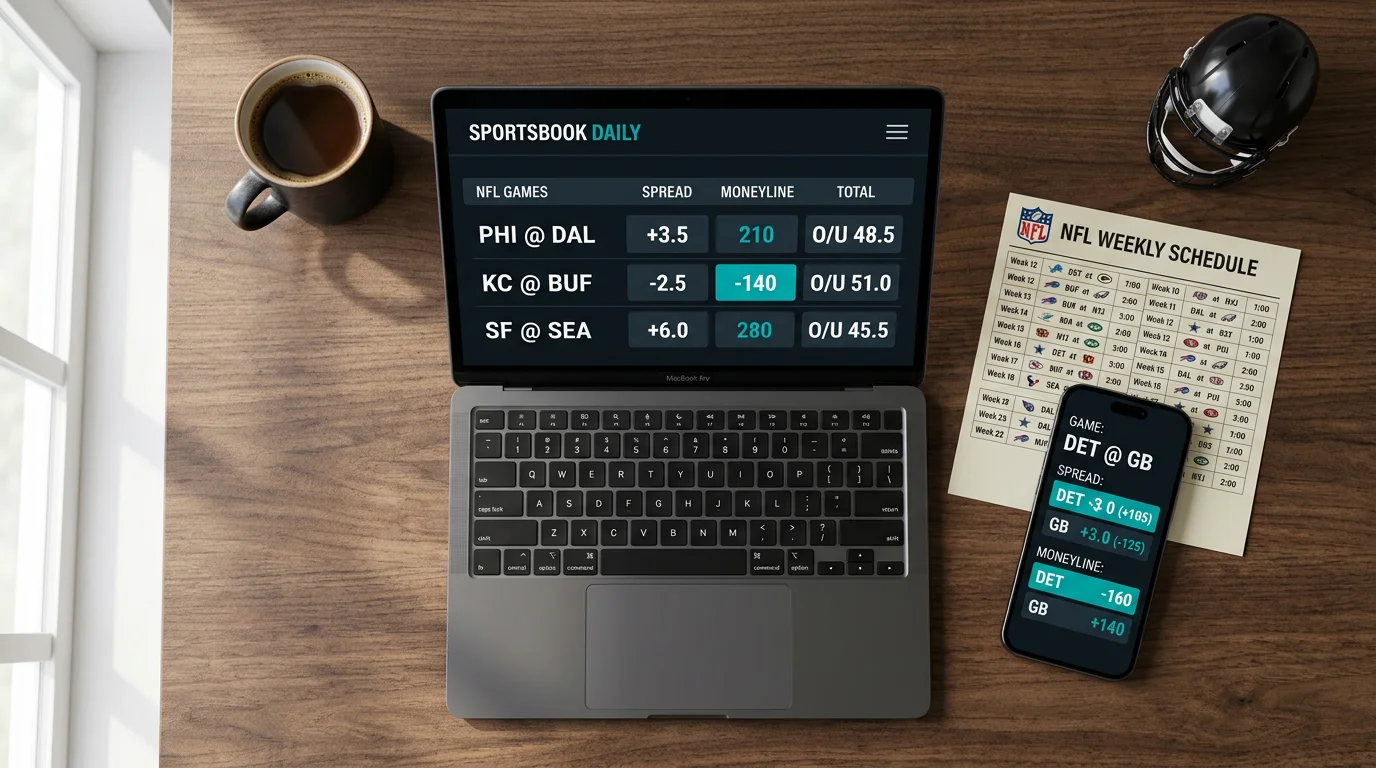
Each of these markets rewards a different kind of analysis. Moneyline betting favours those who can identify mispriced underdogs. Spread betting demands an understanding of margin-of-victory patterns. Totals require you to model scoring environments -- pace, weather, defensive matchups. And player props betting opens up an entirely separate research path focused on individual usage rates and target shares.
The critical thing to understand is that these aren't isolated options -- they interact. A strong opinion on a game's total score should inform your spread bet. A view on a quarterback's passing yardage connects directly to both props and totals. The punters who treat these markets as a connected system, rather than a menu of independent choices, are the ones who build a genuine edge over time.
Moneyline vs Spread: Picking the Right Market
This is the question I get asked more than any other at the start of every NFL season: should I bet the moneyline or the spread? And the honest answer -- the one that annoys people -- is that it depends entirely on the matchup.
The moneyline is binary. You pick a winner, full stop. The spread introduces a condition: your team doesn't just need to win, it needs to win by enough. These two markets price the same event but reward different convictions. If you believe an underdog has a genuine shot at pulling off the upset but you're less confident they'll keep it within a specific margin, the moneyline is your market. If you think the favourite will dominate and cover comfortably, the spread gives you better value than the heavily compressed moneyline odds on a short-priced favourite.
Hypothetical Week 8 matchup
Team A (favourite): Moneyline 1.45 | Spread -6.5 at 1.91
Team B (underdog): Moneyline 2.90 | Spread +6.5 at 1.91
Stake: GBP10 on Team B moneyline = GBP29.00 return if they win outright
Stake: GBP10 on Team B +6.5 = GBP19.10 return if they lose by six or fewer (or win)
| Factor | Moneyline | Spread |
|---|---|---|
| Complexity | Lowest -- just pick the winner | Moderate -- margin of victory matters |
| Best for favourites | Low value (compressed odds) | High value (standard -110/1.91 pricing) |
| Best for underdogs | High value if they win outright | Safety net -- can lose the game and still win the bet |
| Key skill | Identifying live upsets | Modelling margins and key numbers |
| UK equivalent | Match winner (football) | Handicap (Asian handicap parallel) |
In practice, I use both -- often on the same fixture. The spread betting approach is my bread and butter for conference games where talent gaps are narrow and margins cluster around key numbers like three and seven. The moneyline comes out when I spot a live underdog in a divisional rivalry where the public has overreacted to a single bad result. These are complementary tools, not competing philosophies.
Totals, Accumulators and Props at a Glance
If the moneyline and spread are about who wins and by how much, the remaining three core markets take you in a completely different direction. Totals strip the result out entirely. Accumulators multiply your exposure across multiple games. And props zoom in on individual performances. Each one demands a different analytical lens.
Totals -- the over/under -- are my favourite NFL market to analyse, partly because they reward a specific type of research that most recreational punters ignore. You're not predicting a winner. You're modelling a scoring environment. Is this a fast-paced shootout between two high-powered offences? Or a grinding, clock-eating affair between two elite defences? The line the sportsbook sets -- typically somewhere between 38.5 and 55.5 for a regular-season NFL game -- is your target, and your job is to decide whether it's set too high or too low.
Example totals bet
Game total line: 47.5 points
Over 47.5 at 1.91 | Under 47.5 at 1.91
Final score: 31-24 (total 55) -- Over wins
Stake: GBP10 on Over = GBP19.10 return
Accumulators -- parlays, accas, multi-bets, whatever you want to call them -- are the market UK sportsbooks promote most aggressively, and for good reason: the maths overwhelmingly favour the house. Each additional leg multiplies your odds but also multiplies the probability of losing. A four-leg acca at 1.91 per leg pays roughly 13.3/1, but the implied probability of landing all four is just 6.7%. I'm not saying never build one -- I'm saying understand what you're signing up for before you do.
Player props sit at the opposite end of the analytical spectrum. Instead of modelling team-level outcomes, you're drilling into individual performance data: a quarterback's passing yardage, a running back's rushing attempts, a wide receiver's receptions. This is where preparation pays off most directly, because the sportsbooks' pricing models for props are typically less sharp than their team-level markets. The edges are smaller but more frequent, and for punters willing to do the homework on snap counts, target shares, and defensive matchup data, props represent the most consistently exploitable market in NFL betting.
NFL Season Structure: A UK Viewing and Betting Calendar
The first year I tried to follow the NFL seriously from London, I assumed it worked like the Premier League -- a season that runs August to May with a winter break. I was wrong about almost everything. The NFL season is a compressed, intense sprint that creates distinct betting phases, each with its own dynamics and opportunities.
Thirty-two teams, split into two conferences (AFC and NFC), each containing four divisions of four teams. Every team plays 17 regular-season games over 18 weeks -- each franchise gets one bye week, a scheduled week off that has significant implications for betting. The regular season runs from September through early January, followed by a single-elimination playoff bracket that culminates in the Super Bowl in February.
Bye weeks and flex scheduling -- Each NFL team has one week off during the regular season. Bye weeks affect performance data and should be factored into any spread or totals analysis. Flex scheduling allows the NFL to move the most compelling late-season matchups to the premium Sunday Night Football slot, which means kick-off times can shift even after the schedule is published.
For UK punters, the weekly rhythm matters. Regular-season Sundays typically deliver an early slate at 6 PM GMT (the bulk of games), a late-afternoon window at 9:25 PM, and a prime-time fixture at 1:20 AM Monday morning. Thursday Night Football kicks off at 1:15 AM GMT on Friday mornings. Monday Night Football starts at 1:15 AM on Tuesday. Those late-night and early-morning windows are where dedicated UK punters separate themselves -- the casual fans have gone to bed, but the live betting markets are still wide open.
The international calendar adds another dimension. Since 2007, the NFL has staged 62 regular-season games outside the United States, with nine international fixtures planned for 2026 across seven countries. Roger Goodell has been explicit about the league's global ambitions, noting that cities around the world are actively requesting the opportunity to host these games. For UK punters, this matters because London games are played in your time zone, on your doorstep, with market dynamics that differ meaningfully from standard NFL fixtures.
London games 2026: The NFL continues to expand its International Series presence. London has hosted 39 regular-season games since 2007, with Wembley consistently filling its 86,000 capacity and Tottenham Hotspur Stadium drawing sellout crowds of 61,000. The 2026 schedule includes fixtures in London alongside new host cities across Europe and beyond.
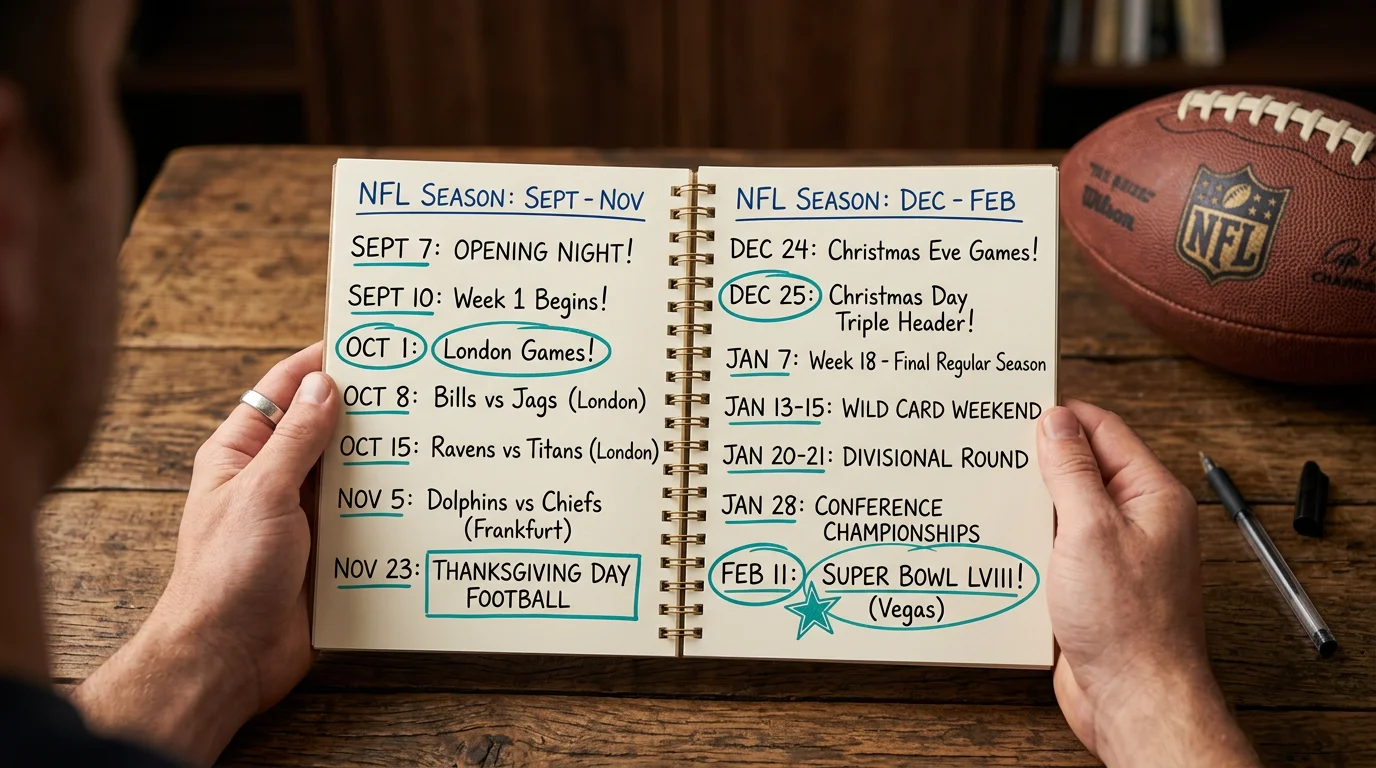
Each phase of the season creates different betting conditions. Preseason data is unreliable -- starters play limited snaps. Weeks 1-4 are volatile as teams find their form. The mid-season stretch (Weeks 5-12) produces the most stable data for modelling. Late-season games (Weeks 13-18) introduce motivation variables -- teams fighting for playoff spots behave very differently from those already eliminated or locked in. And the playoffs? Single elimination changes everything. I'll dig into the strategic implications shortly, but the structural point is this: treating the NFL season as a single block is a mistake. The punters who adjust their approach phase by phase are the ones who last.
How to Place Your First NFL Bet From the UK
Ninety-five per cent of online gambling in the UK happens from home. Three-quarters of young adults aged 18-24 use their mobile phone as the primary device. That means your first NFL wager will almost certainly happen on a sofa, phone in hand, probably on a Sunday evening. Let me walk you through exactly what that process looks like -- not the sanitised version from a bookmaker's FAQ, but the practical reality.
The first decision isn't which bet to place -- it's which sportsbook to use. I won't recommend a specific operator here, but I will tell you that every sportsbook legally offering NFL markets to UK residents must hold a UK Gambling Commission licence. That's non-negotiable. Check it before you deposit a penny. If you're unsure what to look for, the guide to NFL betting sites in the UK covers licensing, market depth, and odds quality in detail. Once you've selected a licensed operator, account creation is straightforward: identity verification (a driving licence or passport), a confirmed address, and a deposit method. The entire process takes about ten minutes.
Now comes the part where most beginners overcomplicate things. Your first NFL bet should be simple. Not an accumulator, not a same game parlay, not a player prop on a cornerback's interception count. Start with a moneyline or a point spread on a single game -- one you've actually watched, or at minimum researched.
Placing a single spread bet: step by step
1. Navigate to the American Football or NFL section of your sportsbook.
2. Select a game from the current week's schedule. For this example, suppose Team A is listed at -3.5 and Team B at +3.5, both priced at 1.91.
3. Tap Team B +3.5 to add it to your bet slip. This means Team B can lose by up to three points and your bet still wins.
4. Enter your stake. For a GBP10 wager at 1.91, your potential return is GBP19.10 (GBP9.10 profit).
5. Review the bet slip -- confirm the selection, odds, and stake are correct.
6. Place the bet. You'll receive a confirmation with a unique bet reference.
Before you confirm any NFL wager
- Verify the sportsbook holds a current UKGC licence
- Set a deposit limit before placing your first bet -- every licensed operator is required to offer this
- Check the game's kick-off time in UK time (GMT or BST depending on season)
- Confirm the odds haven't moved since you added the selection to your slip
- Read the settlement rules for your specific market -- spread, moneyline, and totals each settle differently
- Never stake more than you've already decided you're comfortable losing
The mechanics are straightforward. What matters far more is the mindset you bring. Your first bet is a learning exercise, not a profit opportunity. Pay attention to how the odds move between when you first check them and when you place the bet. Notice which markets are available for different game windows. Track whether the sportsbook offers cash-out options on your selection. All of this is data -- and if you treat it as such from day one, you'll be ahead of the vast majority of punters who treat their first NFL bet as a punt and their second as a chase.
How UK Regulation Shapes Your NFL Betting Options
I once watched a colleague lose access to his account mid-NFL season because the operator he'd been using turned out to be operating without a proper UK licence. His open futures bets -- including a pre-season conference winner wager at very attractive odds -- were void. That experience taught me something I now repeat to every punter I advise: regulation isn't boring bureaucracy. It's the foundation that your entire betting activity rests on.
The UK Gambling Commission oversees every legal betting operation in Britain. As of March 2025, there were 3,086 licensed operators -- a figure that's actually declined by 2.3% as regulatory pressure has tightened. That consolidation is intentional. The UKGC has been increasingly aggressive about enforcement, with Paddy Power Betfair receiving a GBP2 million fine in 2025 for social responsibility failures and AG Communications hit with GBP1.4 million for similar breaches. A legal analysis from Clifford Chance described the 2025 reforms as a decisive shift in UK gambling regulation, positioning the country as a global leader in responsible gambling oversight.
Checking a UKGC licence -- Every legal UK sportsbook displays its licence number in the footer of its website. You can verify any licence directly on the Gambling Commission's public register. If an operator doesn't appear on the register, do not deposit funds.
The 2025 regulatory reforms introduced two changes that directly affect NFL punters. First, a statutory gambling levy came into force on 6 April 2025 -- a mandatory percentage of operator GGY that funds research, prevention, and treatment of gambling-related harm. This replaces the previous voluntary system and means the funding for harm prevention is now guaranteed rather than dependent on operator goodwill.
Second, new stake limits on online slots were introduced from 9 April 2025: GBP5 per spin for those aged 25 and over, GBP2 for those aged 18-24. While these limits target slots specifically rather than sports betting, they signal the direction of travel. The regulatory environment is getting tighter, and sports betting affordability checks are a likely next step.
The statutory levy: Introduced in April 2025, this mandatory contribution from all licensed operators replaces the voluntary system. The funds go directly toward gambling harm research, prevention programmes, and treatment services -- a structural change that ensures support continues regardless of individual operators' commercial decisions.
For NFL punters specifically, regulation means several practical things. Your deposits are protected by segregation requirements. Your ability to self-exclude via GamStop covers all licensed operators simultaneously. Operators are required to intervene if your betting patterns suggest potential harm. And any dispute you have with a sportsbook can be escalated to an approved alternative dispute resolution provider. None of this exists in unregulated markets -- which is precisely why I've never placed a wager with an unlicensed operator and never will.
Data-Driven Strategies: Where Edges Hide in NFL Markets
The single most profitable NFL bet I ever placed wasn't based on a hunch or a tip. It was a spread bet on a mid-season divisional game where the line had moved 2.5 points in three days because the public had overreacted to a blowout loss the previous week. The team I backed hadn't suddenly become terrible -- they'd lost their starting left tackle to injury in a game where everything went wrong simultaneously. The market overreacted. I didn't. That's what data-driven strategy looks like in practice.
Since 2018, when the US Supreme Court struck down the federal ban on sports betting, more than $600 billion in legal wagers have been placed in the United States alone -- over $165 billion just in 2025. That volume of money flowing through NFL markets means the lines are sharper than they've ever been. The low-hanging fruit that existed a decade ago -- blatant mispricings, soft lines at smaller operators -- has largely disappeared. But edges still exist, and they tend to cluster in three areas.
First, situational angles. Teams coming off bye weeks perform differently from teams on short rest. Thursday night games historically produce different scoring patterns from Sunday afternoon fixtures. Cross-country travel affects west coast teams playing 1 PM eastern games. These aren't secret insights -- but the discipline to track them systematically and apply them consistently separates profitable punters from the majority.
Second, overreaction. The public overweights recent results. A team that wins 45-10 in Week 6 gets hammered on the spread in Week 7, even when the blowout was driven by three turnovers that are unlikely to recur. Joey Feazel, the head of football at Caesars Sportsbook, illustrated this perfectly when discussing how the Detroit Lions' loss of both coordinators was expected to create a bigger performance impact than it actually did -- the market priced in a narrative rather than the underlying talent.
Third, line movement. When a spread opens at -3 and moves to -4.5 by kick-off, that movement tells a story. Sometimes it's sharp money from professional syndicates. Sometimes it's public money from casual punters loading up on a popular team. Learning to distinguish between the two is a skill that takes years to develop, but it's the single most valuable analytical tool in NFL betting.

Do
- Track line movements from open to close across multiple sportsbooks
- Focus on specific market types where your research gives you an edge
- Use bye weeks and scheduling irregularities as analytical inputs
- Compare your own assessment to the closing line -- this is your long-term performance metric
Don't
- Chase losses by increasing stakes after a losing week
- Overweight a single game result when evaluating a team's season trajectory
- Ignore line movement by placing all bets at the same time each week
- Assume that the team with the better record is always the correct spread favourite
These principles apply across every NFL market -- but they play out differently on the spread than on the moneyline, and differently again on totals versus props. The next section covers the International Series, where situational angles matter more than anywhere else on the NFL calendar.
NFL London Games: Betting on the International Series
Standing in the concourse at Tottenham Hotspur Stadium before a London Series game in 2023, I overheard two fans debating whether jet lag affects NFL teams enough to matter for betting purposes. One of them dismissed the idea entirely. The other had clearly done some research. The second fan was right -- and the fact that this debate is still happening among casual punters tells me there's value in these games that the market hasn't fully priced in.
The NFL has staged 39 games in London since the International Series began in 2007. The programme expanded to seven international fixtures in 2025 -- a record at the time -- spanning São Paulo, Dublin, London, Berlin, and Madrid. The 2026 calendar pushes that further with nine games planned across seven countries. Roger Goodell has been unambiguous about the trajectory, stating that the league is responding to genuine demand from cities worldwide that want to host these games.
Twenty-five of the twenty-eight London NFL games played between 2007 and 2019 drew at least 83,000 spectators. Wembley fills to its 86,000 capacity so consistently that the NFL treats it as a guaranteed sellout.
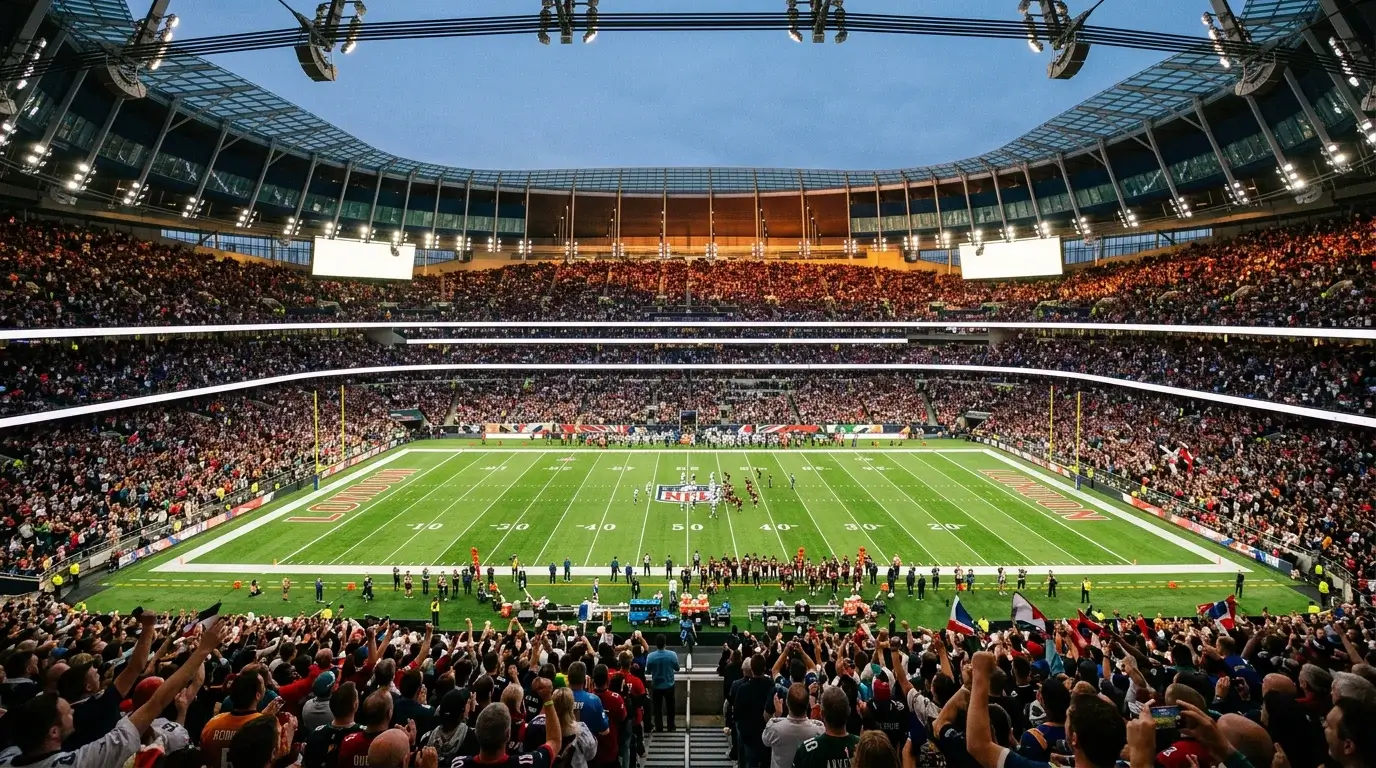
For betting purposes, London games introduce variables that don't exist in standard fixtures. Both teams are away from home. Both have travelled significant distances -- but the direction and duration of travel differ. A team flying east from the West Coast faces a more severe time zone adjustment than one coming from the East Coast. Some franchises arrive a week early to acclimatise; others fly in on Wednesday or Thursday. These logistical decisions directly affect preparation quality, and they're publicly available information that most punters ignore.
The neutral-venue dynamic also warps the home-field advantage that's baked into standard NFL spreads. In a typical game, the home team receives roughly a three-point spread adjustment. In London? That adjustment doesn't apply in the same way. The designated "home" team gets no crowd advantage, no familiarity with the playing surface, and no reduction in travel fatigue. If a sportsbook is pricing London games with the same home-field model it uses for domestic fixtures, there's a structural mispricing waiting to be exploited.
UK search interest: Croydon leads the country for NFL-related search activity, generating 242 queries per 100,000 residents -- nearly 199% above the national average of 81. The concentration of fan engagement in South London and the Home Counties creates a distinct regional market that sportsbooks are beginning to target specifically.
I've tracked London Series lines for six consecutive seasons now, and the pattern is consistent: the market tends to undervalue travel disruption in the first London game of the season and then overcorrect for subsequent fixtures. That oscillation creates opportunities on both sides -- but only if you're watching the specific circumstances of each game rather than applying a blanket rule.
Responsible Gambling: Tools and Mindset for NFL Punters
I've had exactly one conversation that changed how I think about my own betting habits. It was with a sharp I respected enormously -- a profitable punter over five seasons -- who admitted he'd lost more money in two weeks of emotional chasing than he'd made in the previous twelve months. He wasn't stupid. He wasn't reckless by nature. He'd just hit a losing streak at a psychologically vulnerable moment and abandoned every principle he'd built his success on. That can happen to anyone.
Jim Strode, an associate dean at Ohio University's College of Business, put it plainly: sports gambling can be an addictive behaviour that damages finances and mental health, even though the vast majority of bettors start out betting responsibly. That word -- start -- is the one that should give you pause. The trajectory matters more than the starting point.
The participation gap between men and women in UK sports betting is wide -- but problem gambling doesn't discriminate by demographic. It develops through patterns of behaviour that are easy to rationalise in the moment and devastating in retrospect.
Do
- Set deposit limits before the NFL season starts -- and don't raise them during a losing stretch
- Keep a written record of every bet, including your reasoning at the time
- Take breaks during bye weeks -- use the NFL's built-in rest weeks as your own
- Treat your betting bankroll as money already spent, not money you're trying to grow
Don't
- Increase stake sizes after a bad week to try to recover -- the compound effect is devastating
- Use credit cards or borrowed money for any betting activity
- Bet on games you haven't researched just to have action
- Dismiss self-assessment tools as "not for me" -- they exist precisely because everyone thinks that
GamStop and UKGC tools -- GamStop is the UK's national self-exclusion scheme. A single registration blocks you from all UKGC-licensed online gambling operators for a period you choose: six months, one year, or five years. Individual operators are also required to offer deposit limits, loss limits, session time limits, and cooling-off periods. These tools are built into the platform -- use them proactively, not reactively.
The mindset shift I'd encourage is this: responsible gambling isn't a constraint on your betting -- it's part of your strategy. A punter with a clear bankroll, strict staking rules, and the discipline to sit out weeks where they don't have an edge is a better bettor, full stop. The NFL season is 18 weeks long. You don't need action on every game. You don't need to bet every Sunday. And the weeks where you don't bet are often the weeks that save your season.
FAQ
How do I bet on American football in the UK?
Register with a UK Gambling Commission-licensed sportsbook, complete identity verification, and navigate to the American Football or NFL section. Select a game, choose your market (moneyline, spread, or totals are the simplest starting points), enter your stake, and confirm the bet. The entire process happens online or through a mobile app -- 95% of UK online gambling takes place from home, and most young adults use their phones as the primary device.
What are the most popular NFL betting markets?
The six core markets are moneyline (picking the outright winner), point spread (handicap betting on the margin of victory), totals or over/under (betting on the combined score), futures (season-long bets like Super Bowl winner or MVP), accumulators or parlays (combining multiple selections into a single bet), and player props (wagering on individual performances such as passing yards or touchdown scorers). Spread betting is the most wagered market globally, while accumulators are particularly popular among UK punters.
What is the difference between spread betting and moneyline in NFL?
The moneyline requires you to pick the outright winner of a game -- no margin of victory applies. The spread adds a points handicap: the favourite must win by more than the stated number (e.g., -6.5 means winning by seven or more), while the underdog can lose by fewer than the spread and still cover. The moneyline offers higher returns on underdogs but no safety net. The spread provides more balanced odds (typically 1.91 on both sides) and rewards punters who can model margins of victory accurately.
Is it legal to bet on American football online in the UK?
Yes. Online betting on NFL games is fully legal in the UK for anyone aged 18 or over, provided you use a sportsbook licensed by the UK Gambling Commission. The UKGC oversees all legal online betting operations in Britain, and operators must comply with strict regulations covering responsible gambling, deposit protection, and advertising standards. As of March 2025, there were 3,086 licensed operators in the UK. Always verify an operator's licence before opening an account.
What time do NFL games kick off in the UK?
During the regular season, the main Sunday slate kicks off at 6 PM GMT (1 PM Eastern), with a second window at 9:25 PM GMT (4:25 PM Eastern) and the Sunday Night Football fixture at approximately 1:20 AM GMT Monday morning (8:20 PM Eastern). Thursday Night Football starts at roughly 1:15 AM GMT on Friday mornings. Monday Night Football kicks off at around 1:15 AM GMT on Tuesday mornings. London International Series games -- when scheduled -- kick off at 2:30 PM or 6 PM local UK time, making them the most accessible fixtures for British viewers and punters.
How does in-play betting work for NFL games?
In-play or live betting allows you to place wagers while an NFL game is in progress. Markets adjust in real time based on scoring, turnovers, field position, and game momentum. Available live markets typically include adjusted spreads, next scoring method, drive result, and updated totals. Odds move rapidly -- far more so than in football -- because NFL scoring events can swing the game state dramatically. Most UK-licensed sportsbooks offer NFL live betting with cash-out options that let you lock in profit or cut losses before the game ends.
What is an NFL accumulator (parlay) and how do I build one?
An accumulator -- called a parlay in US terminology -- combines two or more individual selections into a single bet. All legs must win for the bet to pay out. The odds multiply with each added leg, creating larger potential returns but significantly lower probability of success. To build one, add multiple selections to your bet slip and select the accumulator option rather than placing them as individual singles. Most UK sportsbooks allow you to combine spread, moneyline, and totals bets from different games into a single acca. Same game parlays, which combine legs from a single fixture, are also available at most major operators.
Articles
Created by the "American Football Betting Online" editorial team.
