
UK NFL Betting Odds: Lines, Margins and Probabilities
 Available in US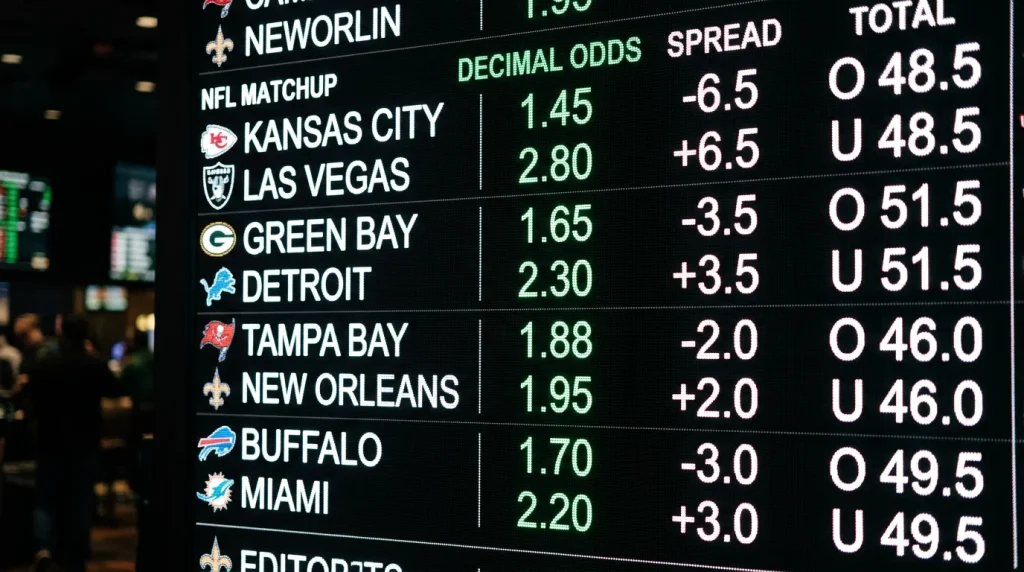
Calculating NFL Betting Odds: Implied Probability and UK Margins
The first time I looked at an NFL odds board on an American website, I thought the numbers were broken. Minus 175? Plus 210? What happened to decimal points and fractions? It took me an embarrassingly long time to realise that American, decimal, and fractional odds are three languages describing the same thing — the bookmaker’s assessment of probability, wrapped in a margin that ensures they profit regardless of the outcome.
UK remote betting generated GGY of 2.6 billion pounds in the year to March 2025, and every penny of that gross yield was built on odds. Understanding how those odds work — not just what they pay, but what they imply about probability and where the bookmaker’s edge hides — is the foundation of informed betting. Most punters never bother. They look at the number, decide if the payout feels “worth it,” and click. That instinct-driven approach is exactly what the sportsbook is counting on.
Decimal, Fractional and American: Three Formats, One Price
I spent a weekend once converting every NFL line I could find between all three formats, just to prove to myself that the maths was consistent. It is. And once you understand the conversion, you can consume American sources, apply their analysis, and act on it through your UK sportsbook without missing a beat.
Decimal odds are the default at most UK sportsbooks for NFL. They represent your total return per unit staked, including the original stake. If the Buffalo Bills are listed at 1.75, a ten-pound bet returns 17.50 pounds — ten pounds of original stake plus 7.50 pounds profit. The beauty of decimal odds is that the maths is one multiplication: stake times odds equals total return. Fixed-odds wagering accounts for roughly 28.2% of the global sports betting market, and the vast majority of that is displayed in decimal format outside North America.
Fractional odds, still popular among UK horse-racing bettors, express profit relative to stake. The same 1.75 decimal price translates to 3/4 fractional — you profit three pounds for every four staked. Fractional odds are intuitive for simple prices like 2/1 or 5/2 but become clumsy for the granular pricing that NFL markets require. What does 8/11 mean to you at a glance? Exactly. Switch to decimal.
American odds use a baseline of 100. Negative numbers indicate the favourite: -175 means you stake 175 to win 100 profit. Positive numbers indicate the underdog: +210 means a 100 stake returns 210 profit. Converting American to decimal is straightforward: for negative odds, divide 100 by the absolute value and add 1 (so -175 becomes 1.57). For positive odds, divide by 100 and add 1 (so +210 becomes 3.10).
My recommendation: set your UK sportsbook to decimal odds for all NFL betting. Use a conversion formula when reading American sources. And never let a format difference prevent you from accessing the enormous volume of American NFL analysis that is freely available online.
From Odds to Implied Probability: Doing the Maths
Odds are just probability wearing a costume. Strip away the format, and every price tells you the same thing: how likely the sportsbook thinks an outcome is — plus a little extra for their trouble.
Converting decimal odds to implied probability is one division: 1 divided by the decimal odds, multiplied by 100 to express as a percentage. At odds of 1.91, the implied probability is 52.4%. At 2.50, it is 40%. At 1.40, it is 71.4%. This conversion is the most useful arithmetic in sports betting, because it lets you compare the sportsbook’s assessment of an outcome to your own.
Here is where it gets interesting. If you convert both sides of an NFL spread market to implied probability and add them together, the total will exceed 100%. At standard pricing of 1.91 on each side, the combined implied probability is 104.7%. That extra 4.7% is the overround — the bookmaker’s built-in margin. It means both sides of the bet carry a price that is slightly worse than fair value, and the sportsbook profits regardless of the outcome.
The overround varies by market type and operator. NFL spread and total markets typically carry overrounds of 4-6%. Moneyline markets carry 3-5% for close games but can exceed 10% when one team is a heavy favourite. Player prop markets carry 6-10% or more, because the pricing is less efficient and the sportsbook compensates for uncertainty with wider margins.
Understanding the overround does not eliminate it — you cannot bet at fair odds because the sportsbook will not offer them. But it tells you exactly how much the market is charging you, which informs your threshold for what constitutes “value.” A bet at 1.91 on a 50% probability event is not value — the breakeven probability at 1.91 is 52.4%, so you need better than a coin flip to justify the wager.
Bookmaker Margin and Overround in NFL Markets
William Hill captured nearly 38% of PPC clicks in UK sports betting in early 2026, with Bet365 at 16.2%. Those operators compete fiercely for your business, and one of the battlegrounds is margin — how much overround they build into their odds.
Lower-margin sportsbooks offer better prices, which means higher returns on winning bets. Over a full NFL season of 100-plus wagers, the difference between an operator charging 4% overround and one charging 6% is substantial — roughly two percentage points of ROI, which can be the difference between a losing and a break-even season.
Comparing margins between operators is straightforward. Pick any NFL game, convert both sides of the spread to implied probability, add them together, and subtract 100. The result is the overround percentage. Do this across five or ten games and you will have a reliable average for each operator. The lowest-margin operators typically sit around 3.5-4.5% on NFL spreads. The highest can reach 6-7%.
Margins also vary within a single operator. Their flagship markets — NFL spreads and totals for marquee games — carry the tightest margins because those markets attract the most volume and the most sophisticated bettors. Niche markets — first-quarter totals, exact-score props, team-specific exotic bets — carry wider margins because the pricing is less competitive and the operator faces more uncertainty.
I maintain a simple comparison table across the four sportsbooks I use most frequently, updated each month during the NFL season. The differences are not dramatic on any single bet, but they compound across hundreds of wagers. Line shopping — checking multiple operators before placing any bet and taking the best available price — is the closest thing to a guaranteed edge in NFL betting. It costs nothing, requires no analytical skill, and improves your long-term results by a measurable margin. For more on how prices compare across different market types, the moneyline guide covers format comparison in context.
Which odds format do UK sportsbooks default to for NFL?
Most UK sportsbooks default to decimal odds for NFL markets, though you can typically switch to fractional or American format in your account settings. Decimal is recommended for NFL betting because the maths is simplest — multiply your stake by the odds to calculate your total return, and divide 1 by the odds to find the implied probability.
How do I calculate implied probability from NFL decimal odds?
Divide 1 by the decimal odds and multiply by 100. For example, odds of 2.00 imply a 50% probability (1 divided by 2.00 = 0.50, times 100 = 50%). Odds of 1.50 imply 66.7%, and odds of 3.00 imply 33.3%. Compare this implied probability to your own assessment of the outcome to determine whether the bet offers value.
Articles
Created by the "American Football Betting Online" editorial team.
