
UK NFL Same Game Parlay and Bet Builder Markets
 Available in US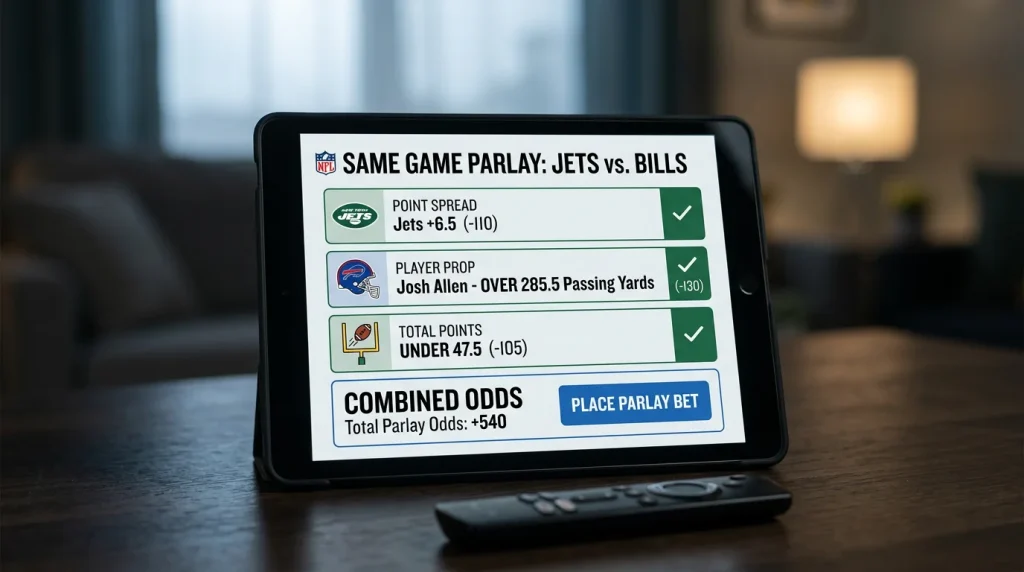
Structuring NFL Same Game Parlays: Correlated Legs and UK Odds
A mate texted me last October with a screenshot of a same game parlay that returned over 4,000 pounds from a two-pound stake. Three legs, one game, all hitting. My first reaction was congratulations. My second was to calculate the implied probability of his selections and compare it to the payout. The sportsbook had priced his combination about 22% below what the correlated probabilities actually warranted. He won, but the house still had the edge — he just happened to land on the right side of variance that night.
Same game parlays — called bet builders at most UK sportsbooks — let you combine multiple selections from a single NFL game into one bet. All legs must win for the bet to pay out, just like a standard accumulator. The difference is that the selections come from the same game, which means they are not independent. And that lack of independence is where both the appeal and the danger lie.
On DraftKings, NFL wagers outpaced every other league in 2024 despite having fewer games, and same game parlays were a major driver of that volume. Sportsbooks promote SGPs aggressively because the correlation adjustments they apply to the pricing give the house a larger margin than standard accumulators. Understanding that pricing is the first step toward using SGPs intelligently rather than as expensive lottery tickets.
How Sportsbooks Price Same Game Parlays
William Hill commands nearly 38% of PPC clicks in UK sports betting, and operators across the market are investing heavily in bet-builder technology. The pricing behind it, though, is deliberately opaque.
In a standard multi-game accumulator, the sportsbook multiplies the odds of each leg because the outcomes are independent — what happens in one game does not affect another. Same game parlays are different. If you back a team to win and also bet the over on total points, those outcomes are positively correlated — winning teams score points, which pushes the total higher. Multiplying the individual odds together would overstate the combined probability and overpay the bettor.
So sportsbooks apply a correlation adjustment. They reduce the combined odds to reflect the fact that the legs are not independent. The problem for the bettor is that the size of this adjustment is opaque. You cannot see the bookmaker’s correlation model or verify whether the adjustment is fair. In practice, sportsbooks tend to overcorrect — they apply a larger correlation discount than the actual statistical relationship warrants, which inflates their margin.
How much does this cost you? In my experience, the effective margin on an NFL same game parlay ranges from 12% to 25%, compared to 4-6% on a standard single bet and 10-15% on a multi-game accumulator with the same number of legs. The wider the correlation between your selections, the larger the margin. Combining a team’s moneyline with a player prop from the same team carries a higher hidden cost than combining a spread pick with a total from the same game.
None of this means you should never use SGPs. It means you should use them with open eyes, understanding that the price you are paying for correlation convenience is significantly higher than what you pay on independent accumulators.
Correlation Between Legs: The Key to Smarter SGPs
If correlation is what the sportsbook is charging you for, then understanding correlation is how you minimise the overcharge. Not all same-game combinations are priced equally, and knowing which leg combinations carry the widest correlation discount helps you avoid the worst-value SGPs.
Strong positive correlation: team moneyline plus team-specific player overs. If you back the Bills to win and also bet Josh Allen over 250.5 passing yards, these outcomes move together. A Bills win likely means Allen had a productive passing game. The sportsbook knows this and discounts the combined odds aggressively.
Moderate positive correlation: game total over plus team-specific player overs. High-scoring games tend to feature high individual performances, so these are correlated — but less directly than team winner plus player stats. The discount is smaller.
Weak or negative correlation: spread favourite plus game total under. A team winning by a large margin can happen in either a high-scoring or low-scoring game. The correlation here is weak, which means the sportsbook’s adjustment should be minimal — and if their model overcorrects, you may actually find value.
The practical strategy is to build SGPs from legs with weak correlation. Pair a spread or total with a player prop from the opposing team, or combine a total with a defensive stat like sacks or turnovers. These combinations are less intuitive and less popular, which means the sportsbook’s pricing model has less public data to calibrate against and is more likely to misprice.
Structuring an NFL Same Game Parlay: Practical Examples
The American football betting market reached $8.52 billion in 2025, and SGPs accounted for a growing share of that handle. Here is how I approach structuring them when the right game presents itself.
I limit SGPs to two or three legs. Every additional leg compounds both the correlation adjustment and the bookmaker’s base margin. A two-leg SGP has a meaningfully better expected value than a four-leg SGP, even if the payout is less exciting. The goal is not to build the biggest possible return — it is to find combinations where the correlation discount is smaller than the actual statistical relationship, which means the sportsbook has undercharged for correlation.
Example structure one: game total under plus a specific running back over on rushing attempts. In a low-scoring game, teams tend to run the ball more frequently to control the clock and shorten the game. These outcomes are weakly correlated — the sportsbook may not fully discount the running back’s attempt volume for the lower-scoring game script, creating a slight edge.
Example structure two: underdog spread cover plus underdog quarterback under on passing yards. When an underdog covers against the spread, it is often because they controlled the game with a run-heavy approach or defensive efficiency, not because their quarterback had a spectacular passing day. These legs are weakly negatively correlated in many matchups, which means the sportsbook’s blanket correlation adjustment may actually work in your favour.
Example structure three: a player prop bet on receiving yards combined with a first-half total. If your analysis identifies a receiver who is likely to see heavy first-half targets due to scripted game-plan emphasis, pairing his yardage over with a first-half total over can capture value that the sportsbook’s model does not specifically account for — because their correlation engine typically operates on full-game relationships, not half-specific ones.
The unifying principle across all these structures is the same: understand the correlation the sportsbook is pricing, identify where their model is likely to overcorrect or undercorrect, and build your SGP around that discrepancy. If you cannot articulate why the correlation between your legs is different from what the sportsbook’s model assumes, you probably do not have an edge — and you are paying a premium for entertainment.
What is same game parlay in NFL betting?
A same game parlay combines multiple selections from a single NFL game into one bet. All legs must win for the bet to pay out. Unlike standard accumulators that combine picks from different games, SGPs involve correlated outcomes from the same match, and sportsbooks adjust the pricing to account for that correlation. Most UK operators offer this feature under the name bet builder.
Why are same game parlay odds lower than a standard accumulator with the same legs?
The odds are lower because sportsbooks apply a correlation adjustment. Selections from the same game are not independent — one outcome influences another. To prevent overpaying bettors for correlated legs, the sportsbook reduces the combined odds below what you would get by multiplying the individual prices. This adjustment typically gives the house a wider margin than on a standard multi-game accumulator.
Articles
Prepared by the American Football Betting Online editorial staff.
