
UK NFL Accumulators: Parlay Bets and Odds Calculations
 Available in US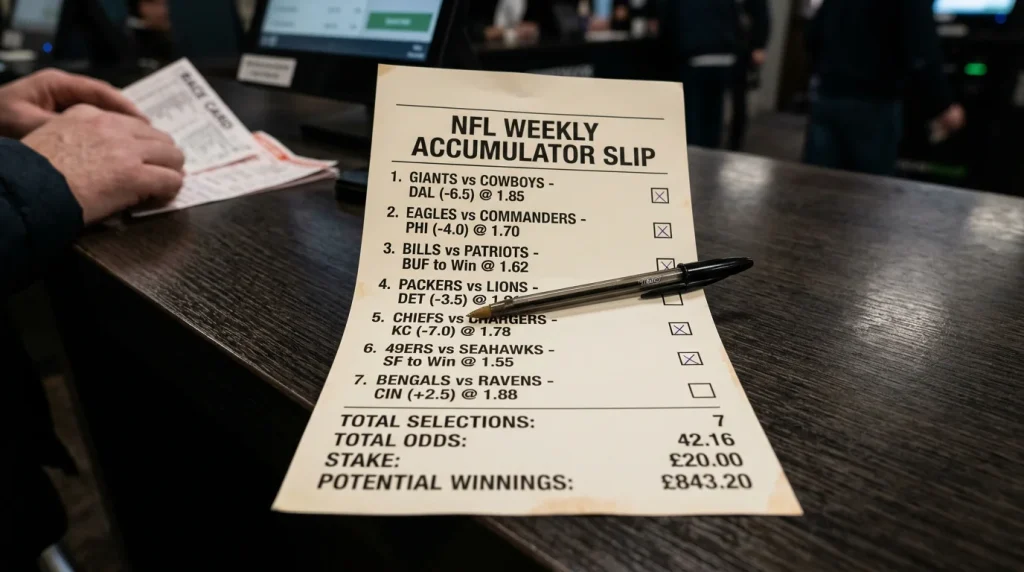
NFL Parlay Strategy: Building High-Value Accumulators in the UK
I have a confession: the biggest single payout I ever received from an NFL bet was a six-leg accumulator. It landed on a Week 14 Sunday in 2019, and the return was just over 800 pounds from a five-pound stake. I felt like a genius for about forty-eight hours — until I sat down and calculated how much I had lost on failed accumulators over the previous three seasons. The number was not flattering.
Accumulators — parlays in American English, accas in the shorthand of UK betting culture — are the most popular bet type among recreational punters for a reason that has nothing to do with expected value. They are exciting. A small stake turns into a potentially life-changing return, and every leg that lands ratchets up the dopamine. Around 10% of the UK adult population bets on sport online, and a huge proportion of those punters have placed an accumulator at some point. The question is not whether you will try one — it is whether you understand the maths well enough to use them strategically rather than as lottery tickets.
How NFL Accumulators Calculate Odds
The mechanics are deceptively simple, which is part of the problem. An accumulator multiplies the decimal odds of each individual selection to produce a combined price. Two legs at 1.90 each produce combined odds of 3.61. Three legs at 1.90 give you 6.86. Four legs: 13.03. The numbers grow fast, and that rapid escalation is what makes accas feel like value even when they are not.
Here is the catch that most punters miss. Each set of odds already includes the sportsbook’s margin — typically 4% to 6% on NFL spread and totals markets. When you multiply four sets of odds together, you are not just multiplying the probabilities. You are multiplying the margins too. A 5% edge for the bookmaker on a single bet becomes roughly a 19% edge on a four-leg accumulator, because the overround compounds with each additional leg.
Put that in concrete terms. If each leg of a four-fold has a true 50% chance of winning, the fair combined odds should be 16.00 (2.00 multiplied four times). But the sportsbook prices each leg at 1.91, so the actual combined payout is 13.32. You are being paid 13.32 for something worth 16.00. That 17% haircut is the real cost of an accumulator, and it is invisible unless you run the numbers.
Does that mean accumulators are always a bad bet? No. It means you need to understand what you are paying for the privilege of combining legs, and make a conscious decision about whether the entertainment value justifies the mathematical disadvantage.
Selecting Legs: Correlation, Diversification and Sizing
If you are going to build NFL accumulators — and I suspect you are, because they are genuinely fun — the selection process matters enormously. Three principles guide my approach.
First, correlation. Standard accumulators assume each leg is independent, but NFL outcomes are not always independent. If you back the Bills to cover the spread and also bet the over on the same game, those outcomes are positively correlated — a team covering a spread often contributes to a higher total score. Sportsbooks now account for this through same game parlay pricing, which adjusts the combined odds to reflect correlation. But across different games, correlation is minimal, which means a multi-game accumulator is priced more fairly than a same-game combo.
Second, diversification across market types. An accumulator with four moneyline favourites has a very different risk profile from one mixing spreads, totals, and a player prop. The moneyline-heavy acca will hit more often but pay less, because heavy favourites have low individual odds. A mixed-market accumulator offers more variance but can exploit specific edges across different bet types. I prefer mixing two or three spread selections with one totals pick — it keeps the odds reasonable while spreading risk across different analytical frameworks.
Third, leg count. Every additional leg compounds the bookmaker’s margin and reduces your probability of winning. The American football betting market is projected to reach $14.49 billion by 2030, which means sportsbooks are investing heavily in pricing accuracy. The more legs you add, the more you are betting against that pricing power. My hard rule: never exceed four legs in an NFL accumulator. Three is better. Two is ideal if you are treating accas as a strategic tool rather than a recreational flutter.
I also apply a simple filter to each potential leg: would I bet this as a single? If the answer is no, it does not belong in an accumulator. An acca should be a collection of your strongest individual opinions, not a dustbin for selections you are not confident enough to back on their own.
The Maths Behind Accumulator Risk and Reward
Let me show you exactly what the numbers look like across different leg counts, using standard NFL spread odds of 1.91 per leg.
A two-fold at 1.91 per leg returns 3.65 on a one-unit stake. Your break-even win rate is 27.4%, but the true probability of both legs winning (assuming each is a coin flip at 50%) is 25%. That means the house edge on a two-fold is relatively modest — about 9% — and if you have a genuine edge on each leg, you can overcome it.
A three-fold returns 6.97. Break-even: 14.3%. True probability: 12.5%. House edge: around 13%. Still manageable if your individual selections carry genuine value.
A four-fold returns 13.32. Break-even: 7.5%. True probability: 6.25%. House edge: roughly 17%. You are now paying a serious premium, and each leg needs to carry independent value to justify the compounding margin.
A six-fold — the kind that produces the screenshots people post on social media — returns 48.59. Break-even: 2.06%. True probability: 1.56%. House edge: about 24%. At this point, you are paying nearly a quarter of your expected return to the sportsbook in built-in margin. The entertainment value might justify it. The mathematical expectation does not.
The practical takeaway is this: if you have a genuine analytical edge on individual selections, concentrate that edge into singles or small two- and three-fold accumulators. Spreading your edge across six or seven legs dilutes it below the point where it can overcome the compounding margin. Save the big accas for a small entertainment budget that you are prepared to lose entirely — because over any meaningful sample, you will.
How many legs should an NFL accumulator have?
Two to three legs offers the best balance between enhanced odds and manageable house edge. Each additional leg compounds the bookmaker"s margin by roughly 4-6%, so a four-fold already carries a significant mathematical disadvantage. Keep leg counts low and only include selections you would confidently back as singles.
Do UK sportsbooks offer accumulator insurance on NFL bets?
Several UK-licensed operators offer accumulator insurance or bonus promotions on NFL accumulators, particularly during the regular season and playoffs. These typically refund your stake as a free bet if one leg loses. Read the terms carefully — the refund is usually a free bet with restrictions rather than cash, and the promotion may require a minimum number of legs or minimum odds per selection.
Articles
Published by the American Football Betting Online team.
