
Costly NFL Betting Mistakes for UK Punters to Avoid
 Available in US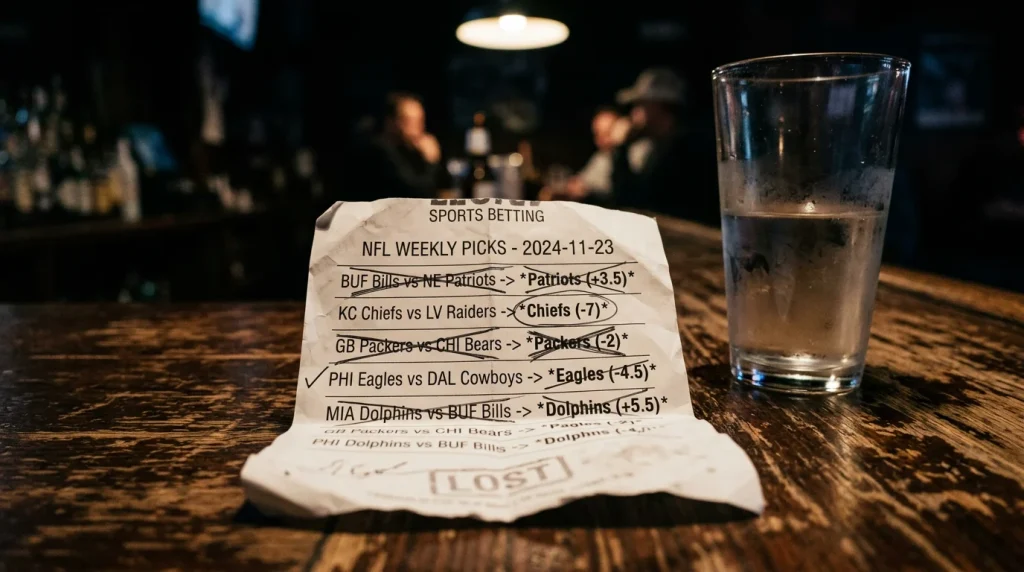
Common NFL Betting Errors: Chasing Losses and Ignored Line Moves
The sharpest NFL analyst I know — a man who can recite DVOA rankings from memory and builds proprietary models in his spare time — lost 11% of his bankroll in the 2023 season. His analysis was excellent. His process was sound. His staking was a disaster. He bet three times his standard unit on “certainties” that were not certain, and those oversized losses wiped out the gains from his well-researched selections.
Around 10% of the UK adult population bets on sport online, and the vast majority of them make the same handful of errors repeatedly. These are not analytical mistakes — they are behavioural ones. You can be right about the game and still lose money if the way you bet undermines the edge your analysis provides. Recognising these patterns in your own betting is the first step toward eliminating them.
Chasing Losses: The Compound Effect on Your Bankroll
Jim Strode, who studies gambling markets at Ohio University, has observed that sports gambling can be addictive and damaging to finances and mental health, but that the vast majority of bettors start betting responsibly. Chasing losses is the mechanism through which responsible betting becomes irresponsible betting, and it happens faster than most people expect.
Here is how it works. You lose three bets on Sunday afternoon. You are down 15 units. The Sunday Night game is about to kick off, and you have an opinion — not a strong one, but an opinion. Normally, you would pass. But you are down, and a two-unit bet on the night game could claw back some of the afternoon losses. So you bet. And because you are emotionally compromised, you bet three units instead of two. The night game loses. Now you are down 18 units, and the Monday Night game is tomorrow.
The compound effect is not just financial — it is cognitive. Each successive loss reduces your decision-making quality because the emotional stakes increase. The fourth bet of a losing streak is placed under more psychological pressure than the first, which means it is more likely to be a poor decision, which means it is more likely to lose, which increases the pressure on the fifth bet. The spiral feeds itself.
My circuit breaker: I set a hard daily loss limit of five units. When I hit it, I close the sportsbook app and do not open it again until the next day. No exceptions. The rule has saved me from dozens of bad decisions over the years, and the money I have not lost on chasing bets is worth more than any clever analysis I have ever produced.
Recency Bias and Overreaction to One Result
NFL regular-season viewership hit 18.7 million per game in 2025, and all of those viewers walked away from each game with a fresh narrative. The team that won by 30 points is “unstoppable.” The team that lost by 30 is “falling apart.” Neither assessment is based on a meaningful sample. It is based on one game, and one game in a 17-game season is noise.
Recency bias is the tendency to overweight the most recent information at the expense of the broader dataset. In NFL betting, it manifests as dramatic line overreaction to last week’s results. A team that dominates on Sunday sees their spread jump two or three points the following week, often beyond what a single performance justifies. The team they embarrassed sees an equal and opposite correction.
I track a metric I call “post-blowout regression” — the spread performance of teams in the game immediately following a win or loss by 20 or more points. Over eight seasons of data, the pattern is consistent: teams that won by 20-plus tend to underperform their spread the following week, and teams that lost by 20-plus tend to outperform theirs. The market overreacts to extreme results because the public anchors on the most vivid recent memory.
The antidote is simple but difficult to execute: weight your analysis toward rolling multi-game samples rather than single-game results. A five-game rolling average of efficiency metrics tells you far more about a team’s true quality than any individual performance. When the betting line moves sharply after one game, check whether the underlying data supports the move. If it does not, you may have found a recency-bias edge.
Ignoring Process: Results-Based Thinking in NFL Betting
More than $600 billion in legal wagers have been placed in the United States since 2018, with over $165 billion in 2025 alone. That volume tells you the market is efficient and that short-term results are a poor indicator of skill. And yet, the most common mistake I see among UK NFL bettors is evaluating their approach based on results rather than process.
A bettor who wins four out of five bets on a Sunday feels like a genius. A bettor who loses four out of five feels like an idiot. Neither assessment is warranted based on a five-bet sample. At a 55% win rate — which would make you one of the best NFL bettors in the world over a large sample — you will lose four of five bets roughly 5% of the time. It happens regularly. It does not mean your process is broken.
Results-based thinking leads to constant tinkering. After a losing week, you change your approach. After a winning week, you lock it in. The problem is that variance in a 17-week NFL season is enormous. You can follow a perfectly sound process and still have three consecutive losing weeks. If you abandon the process in response to those losses, you never give it enough time to demonstrate its edge.
The correct evaluation framework is closing line value, measured over a minimum of 100 bets. If you are consistently betting at better odds than the closing line, your process is identifying value regardless of whether individual bets win or lose. If you are consistently betting at worse odds than the closing line, your process needs adjustment regardless of how many bets happen to win. For connecting bankroll discipline to this process-focused approach, the bankroll management guide covers the staking framework that keeps your exposure consistent while the variance plays out.
What is the biggest mistake new NFL bettors make?
The biggest mistake is sizing bets emotionally rather than systematically. New bettors increase their stakes on games they feel strongly about and reduce them on less exciting matchups, which means their largest bets carry the most emotional bias and the least analytical rigour. Flat staking — betting the same amount on every selection — eliminates this problem and produces more consistent long-term results.
How does chasing losses affect long-term NFL betting results?
Chasing losses compounds both financial damage and decision-making deterioration. Each successive bet placed under the pressure of recovering losses is more likely to be poorly reasoned and oversized. Over a full season, the cumulative cost of chasing often exceeds the original losses that triggered the behaviour. Setting a hard daily loss limit and stopping when you reach it is the most effective preventive measure.
Articles
Prepared by the American Football Betting Online editorial staff.
