
NFL Teaser Bets and Alternate Spreads for UK Punters
 Available in US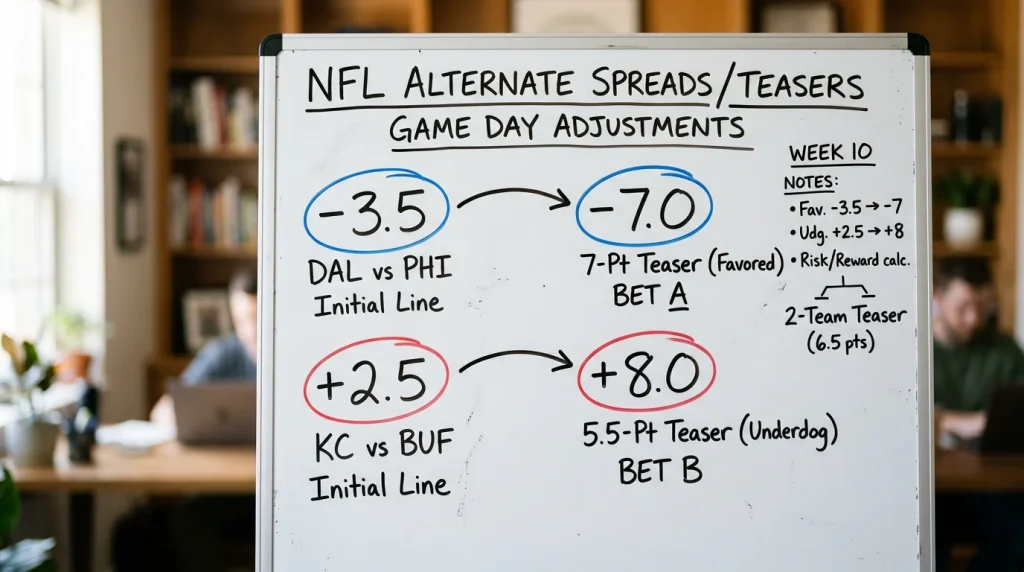
Alternate NFL Spreads: Buying Points and Teaser Bet Value
The first time I saw an alternate spread menu at a UK sportsbook, I thought it was a bug. The standard line was Bills -3.5 at 1.91, but right below it sat Bills -7.5 at 2.80, Bills -1.5 at 1.55, Bills +3.5 at 3.40, and about a dozen other variations. It was like walking into a restaurant and discovering the menu had a secret second page with every dish prepared slightly differently.
Alternate spreads and teaser bets both let you adjust the point spread away from the standard line — in exchange for different odds. They are not exotic. They are not advanced in the sense of requiring complicated maths. But they are misunderstood by most UK punters, who either ignore them completely or use them recklessly without understanding the pricing logic underneath.
The American football betting market is projected to grow from $8.52 billion in 2025 to $14.49 billion by 2030. A significant chunk of that expansion comes from markets exactly like these — products that give bettors more control over the terms of their wager. Understanding when these adjusted lines offer genuine value, and when they are just the sportsbook giving you enough rope to hang yourself, is a meaningful edge in its own right.
How NFL Alternate Spread Lines Work
An alternate spread is exactly what it sounds like: a spread set at a different number from the standard line. If the standard spread is Kansas City -6.5 at 1.91, an alternate might offer Kansas City -3.5 at 1.45 (a shorter spread, lower payout) or Kansas City -10.5 at 2.75 (a wider spread, higher payout). The sportsbook offers a full menu of alternate lines, typically in half-point increments from the standard line in both directions.
The pricing reflects the changing probability of each outcome. Moving the spread by three points in the bettor’s favour — say from -6.5 to -3.5 — dramatically increases the probability of covering, so the odds drop accordingly. Moving it three points against you — from -6.5 to -9.5 — reduces the probability of covering but increases the payout.
UK punters sometimes confuse alternate spreads with “buying points,” but the concept is identical. Buying a point means moving the spread half a point in your favour at a higher price. If the standard line is -7 at 1.91, you can buy it down to -6.5 at perhaps 1.80. The cost of that half-point varies depending on the number you are crossing — and this is where key numbers become essential.
The critical thing to understand is that the sportsbook prices each alternate line with its own margin. They are not simply recalculating fair odds and adding a flat percentage. The margin on alternate spreads is typically wider than on the standard line, especially at the extremes. A team at +14.5 might carry a 7-8% margin, compared to 4-5% on the standard spread. That built-in tax increases the further you deviate from the market consensus line.
Key Numbers in NFL Scoring and Why They Matter
NFL games are not decided by random numbers. They cluster around specific margins of victory because of the sport’s scoring structure: touchdowns are worth six points (plus a near-certain extra point for seven), and field goals are worth three. This creates natural clustering around margins of 3, 7, 10, 6, 14, and 4 — in roughly that order of frequency.
The 2025 NFL regular season averaged 18.7 million viewers per game, and if you watched enough of those games, you noticed how often the final margin landed on three or seven. Three is the single most common margin of victory in NFL history, because a late field goal can swing the result by exactly that amount. Seven is second, because a touchdown-plus-extra-point is the standard scoring unit.
Key numbers matter enormously for alternate spreads because crossing a key number changes the probability of covering more than crossing a non-key number. Moving a spread from -3.5 to -2.5 crosses the number three, which means you now cover in all the games decided by exactly a field goal. That one-point move is worth far more than moving from -4.5 to -3.5, which crosses four — a relatively uncommon margin of victory.
The practical implication: buying through three and seven is expensive but often justified. Buying through non-key numbers like five, eight, or nine is usually a waste of money because the probability change is minimal relative to the cost. Before selecting any alternate spread, check which key numbers your adjustment crosses and whether the price reflects fair value for that probability shift.
Teaser Bet Strategy: When Buying Points Pays Off
A teaser is a specific type of multi-bet where every leg receives a fixed number of additional points in the bettor’s favour. The standard NFL teaser gives you six extra points on each selection, and you must win every leg for the bet to pay out — just like an accumulator, but with adjusted spreads.
The classic teaser strategy, tested extensively by sharp bettors over decades, is the two-team, six-point teaser crossing key numbers. Take a team at -7.5 or -8 and tease it to -1.5 or -2, crossing through seven and three. Or take a team at +1.5 or +2 and tease it to +7.5 or +8, again crossing both key numbers in the bettor’s favour. The historical win rate on legs that cross through both three and seven is significantly higher than the break-even threshold for a standard two-team teaser priced at around -1.10 (decimal 1.91).
Why does this work? Because concentrating all six points on key numbers maximises the probability gain per point purchased. Six points spread across non-key territory barely moves the needle. Six points that traverse both three and seven convert a large number of close losses into wins.
The conditions for a profitable teaser are specific. Both legs must cross through three and seven. Both legs must be on the correct side of those numbers — meaning the standard spread must be between -7 and -8.5, or between +1 and +2.5. And the teaser must be limited to two legs, because adding a third compounds the margin and dilutes the edge. Three-team teasers are priced more aggressively by sportsbooks precisely because they are popular, and the added leg pushes the break-even win rate beyond what the key-number advantage can sustain.
I run about ten to fifteen teasers per NFL season, only when the numbers align perfectly. Most weeks, they do not. That restraint is the strategy. If you find yourself teasing four or five games every Sunday, you are forcing the play and the edge has evaporated. For a deeper look at how the standard NFL point spread works and when to use it, that piece covers the foundation you need before venturing into alternate territory.
What are the most common key numbers in NFL scoring?
Three and seven are the two most important key numbers. Three is the most frequent margin of victory because it equals one field goal, and seven represents a touchdown plus extra point. Other notable key numbers include 10, 6, 14, and 4. When adjusting spreads or building teasers, crossing through three and seven provides the largest probability improvement per point purchased.
Is a two-team six-point teaser a profitable NFL betting strategy?
A two-team six-point teaser can be profitable over a large sample when both legs cross through the key numbers of three and seven. The historical win rate on legs meeting this criterion exceeds the break-even threshold for standard teaser pricing. The strategy requires discipline — only bet when the standard spread falls in the correct range, and never add a third leg, as the additional margin erodes the edge.
Articles
Created by the "American Football Betting Online" editorial team.
