
NFL Bankroll Management and Staking Plans for UK Punters
 Available in US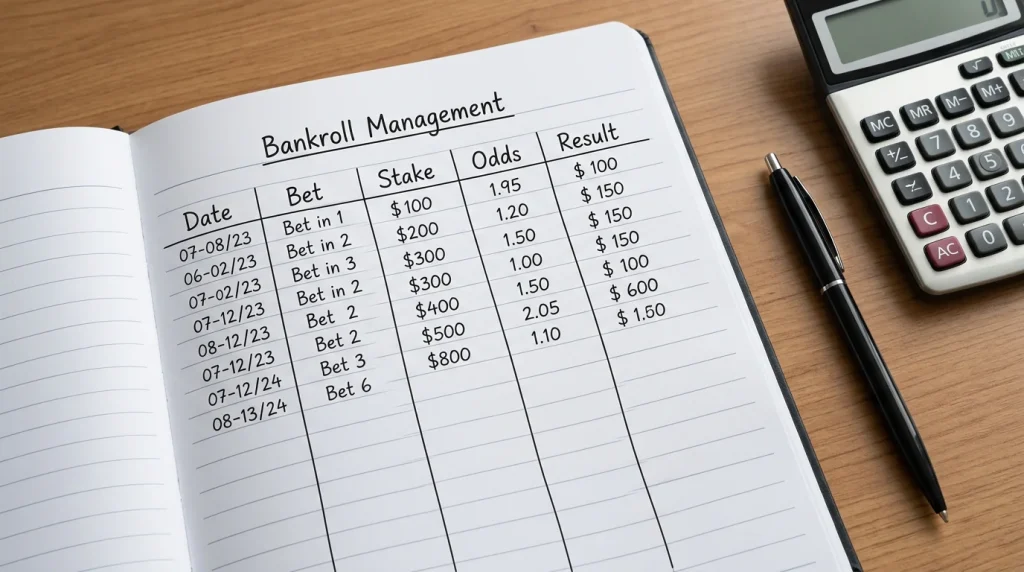
NFL Staking Plans: Unit Sizing and Betting Budget Protection
Nobody has ever sent me an excited text about their bankroll management strategy. Nobody has ever posted a screenshot of a well-maintained staking spreadsheet with the caption “look at this beauty.” And yet, of all the skills I have developed across eleven years of NFL betting, bankroll management is the one that has saved me the most money. Not made — saved. The distinction matters.
Around 10% of the UK adult population bets on sport online. Some of them are profitable. A slightly larger number break roughly even. The majority lose. And in my experience, the dividing line between the profitable and the unprofitable is not analytical ability — it is how they size their bets relative to their available capital. A sharp bettor with terrible bankroll management will go broke. A mediocre bettor with disciplined staking will survive long enough to improve.
Setting Your Unit Size and Bankroll
Your bankroll is the total amount of money you have dedicated exclusively to NFL betting. Not your savings. Not next month’s rent. Not the money in your current account that you “probably will not need.” A bankroll is a ring-fenced sum that you can lose entirely without any impact on your financial obligations or quality of life.
For most UK punters starting out, a sensible bankroll is somewhere between 100 and 500 pounds. If that number makes you flinch, it is too high. Reduce it until the prospect of losing the entire amount feels disappointing but not distressing. That emotional threshold is your true bankroll.
Your unit size is derived from your bankroll. One unit represents a single standard bet. The conventional wisdom is to set one unit at 1% to 3% of your total bankroll. On a 200-pound bankroll, that means a unit size of two to six pounds. On a 500-pound bankroll, five to fifteen pounds.
I use 2% as my default. It is conservative enough to absorb a losing streak without depleting the bankroll, and large enough to generate meaningful returns when I am on the right side. At 2%, I can lose 20 consecutive bets — which is a catastrophic run by any standard — and still have 67% of my bankroll remaining. That margin of safety is the entire point.
One mistake I see constantly: punters set their unit size based on what feels like a satisfying wager rather than what the maths supports. Five pounds does not feel exciting when you are watching a primetime NFL game with your mates. But excitement is not the goal. Survival is the goal. Excitement comes from making good decisions, not from risking money you cannot afford to lose.
Flat Staking vs Percentage Staking: Which Works for NFL
The estimated $30 billion in legal NFL bets during the 2025 season were placed using every staking method imaginable, from Kelly Criterion models to “whatever feels right.” Two methods dominate the practical landscape for non-professional bettors: flat staking and percentage staking.
Flat staking means every bet is the same size — one unit, regardless of confidence level, odds, or market type. A spread bet at 1.91 gets one unit. An underdog moneyline at 3.50 gets one unit. A player prop at 2.20 gets one unit. The simplicity is the strength. You never need to decide how much to bet, which eliminates one entire category of emotional decision-making. Flat staking also produces the cleanest performance data, because every bet has equal weight in your results.
Percentage staking adjusts the bet size based on your current bankroll. If you stake 2% of your bankroll and your bankroll grows from 200 to 240 pounds, your unit size increases from four to four pounds eighty. If the bankroll drops to 160, your unit decreases to three pounds twenty. This self-adjusting mechanism means you bet more when winning and less when losing, which is mathematically optimal for long-term growth but introduces a complication: you need to track your bankroll and recalculate before every bet.
For NFL betting specifically, I recommend flat staking with a single exception. If you have identified a bet where your edge is significantly larger than normal — say your model gives you a 58% probability on a line priced at 50% — you can increase to 1.5 or 2 units. Never more than that. The temptation to “go big” on a strong opinion is the single most common bankroll-management failure I see, and it destroys more punters than bad handicapping ever will.
Variable staking systems like the Kelly Criterion are theoretically superior but practically dangerous for recreational bettors. Kelly requires an accurate estimate of your edge on every bet, and even small errors in that estimate produce wildly suboptimal stake sizes. Unless you have a proven, calibrated model with a multi-year track record, flat staking is safer and nearly as effective. Protecting your capital is essential before you start implementing advanced NFL betting strategies like fading the public or hunting for line value.
Budgeting Across the 18-Week NFL Season
The American football betting market is projected to grow from $8.52 billion in 2025 to $14.49 billion by 2030, which tells you this sport’s wagering ecosystem is expanding rapidly. But your personal budget should not expand with it. One of the most important bankroll decisions you make happens before the season starts: how much are you willing to invest across the entire 18-week regular season and the four-week playoff window?
I divide my annual NFL bankroll into two portions: 80% for the regular season and 20% reserved for the playoffs. The regular-season allocation covers roughly 16 to 20 bets per week across 18 weeks — though I rarely bet more than eight or ten games in any given week. The playoff reserve ensures I have fresh capital for the postseason, when the games are highest-profile and my analysis is sharpest because the sample size is largest.
Within the regular season, I front-load my activity slightly toward weeks 4 through 12. The early weeks (1-3) have the smallest sample of current-season data, which means my projections carry the most uncertainty. The late weeks (13-18) feature more reliable data but also more public attention and sharper lines. The middle stretch offers the best combination of data reliability and market inefficiency.
Track everything. Every bet, every stake, every outcome, every closing line. I use a simple spreadsheet with columns for date, game, market, odds at placement, closing odds, stake, result, and profit/loss. At the end of each month, I review my overall ROI, my closing line value, and my staking discipline (did I deviate from flat staking at any point?). That monthly review is where the real learning happens — not in the post-game euphoria of a winning Sunday.
The NFL season is long enough to recover from a bad stretch but short enough that a blown bankroll does not get a second chance until the following September. Protect the bankroll, trust the process, and let the variance play out over a full season rather than reacting to any individual week. For a broader look at how staking fits into a complete NFL betting strategy, that piece connects the bankroll framework to the analytical process.
Apply these staking plans consistently when placing your wagers through the top American football betting site recommended for UK punters.
How do I manage my bankroll for NFL betting?
Set aside a fixed amount of money exclusively for NFL betting — an amount you can lose entirely without financial hardship. Define your unit size at 1-3% of that bankroll. Bet in flat units for consistency, track every wager in a spreadsheet, and review your results monthly. Divide your season bankroll between regular season and playoffs, and never increase your unit size in response to a losing streak.
What percentage of my bankroll should a single NFL bet be?
A single NFL bet should represent 1-3% of your total bankroll. At 2%, a 200-pound bankroll produces a four-pound standard bet. This sizing allows you to absorb losing streaks of 15-20 bets without depleting your capital. Only increase to 1.5-2 units on rare occasions where your analytical edge is significantly above average, and never exceed 5% of your bankroll on any single wager.
Articles
Prepared by the American Football Betting Online editorial staff.
