
Advanced NFL Betting Strategy and Line Movement
 Available in US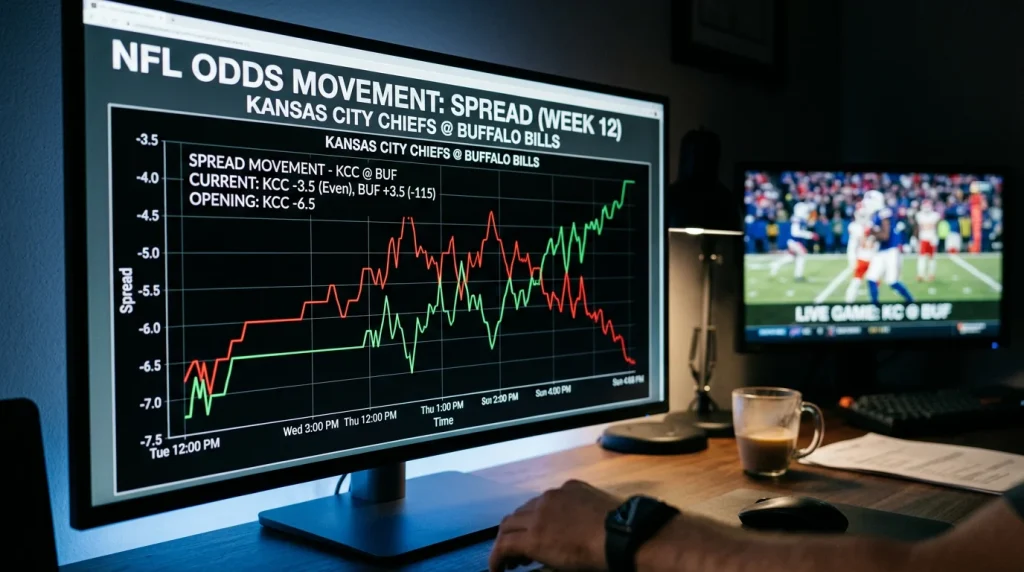
Value Betting Strategy: Tracking NFL Line Movement in the UK
Three years into betting NFL, I kept a spreadsheet tracking every wager I placed. After 400 bets, I was down 6.2% on turnover. Not catastrophic, but not sustainable. When I reviewed the data, the pattern was obvious: my “gut feel” bets lost at a 46% rate, while my data-backed selections hit at 54%. The gut was costing me everything the data was earning, and then some.
Since the repeal of the Professional and Amateur Sports Protection Act in 2018, more than $600 billion in legal wagers have been placed in the United States alone — with over $165 billion in 2025. The NFL drives more betting volume than any other league despite having the fewest games per team. That level of liquidity means these markets are efficient, priced by sophisticated models, and shaped by professionals who do this full-time. You cannot out-intuit that machinery. You need a system.
Strategy in NFL betting is not about predicting who wins. It is about identifying where the price is wrong. The sportsbook sets odds that reflect a probability. If your independent assessment of that probability is higher than what the odds imply, you have found value. If it is not, you pass. That discipline — passing on games where you have no edge — separates strategic bettors from recreational ones more than any single analytical technique.
Value Betting: Identifying Mispriced NFL Lines
The first time I consciously identified value, I nearly talked myself out of betting it. It was a Week 12 game, a 2-8 team hosting a 7-3 side, and the spread was only 6.5. Every fibre of my football brain said to take the favourite. But the underlying efficiency metrics — adjusted yards per play, defensive pressure rate, third-down conversion percentage — told a different story. The losing team was performing far better than their record suggested, and the winning team had been bailed out by an unsustainable turnover differential.
I took the underdog. They covered by ten. That single experience rewired my approach permanently.
Value exists when a sportsbook’s implied probability is lower than the true probability of an outcome. The maths is simple: convert decimal odds to implied probability (1 divided by the odds), compare that to your own estimated probability, and bet only when the gap is meaningful. If a sportsbook prices a team at 2.50 (40% implied), and your model says they win 48% of the time, that is an 8-percentage-point edge — a significant discrepancy worth acting on.
The challenge is in the estimation. You need a framework that produces probabilities you can trust. I use a blend of efficiency metrics, situational adjustments (rest, travel, division familiarity), and market-derived information from early line moves. The blend matters more than any single input. A model built entirely on DVOA will miss injury impacts. A model built entirely on recent results will overfit to noise. Combining four or five weakly predictive factors into a single estimate produces a far more robust probability than any one factor alone.
One practical shortcut: track closing line value. If you consistently bet at better odds than where the line closes at kick-off, you are likely finding genuine value — even if individual bets lose. Closing line value is the closest thing to a long-term profitability indicator that exists in sports betting.
Fading the Public: When Contrarian Betting Works
Every Monday morning, I check the previous week’s public betting percentages against the results. Over ten seasons of tracking this, the pattern is unmistakable: when more than 75% of spread bets land on one team, the other side covers at a rate meaningfully above 50%.
Why? Because sportsbooks shade their lines toward popular teams. They know the public will bet the Chiefs, the Cowboys, and whoever won impressively last week. By moving the spread half a point or a full point toward the popular side, the book attracts balanced action on the less popular team while collecting slightly more juice on the larger volume side. The result is that the contrarian side often gets a better number than the true probability warrants.
On DraftKings, NFL wagers exceeded those of every other league in 2024 despite fewer games — a testament to the sheer public enthusiasm driving these markets. That enthusiasm is your raw material as a contrarian bettor.
Fading the public is not a blind strategy. It works best in specific conditions: primetime games (where casual viewership drives one-sided action), marquee matchups featuring nationally popular teams, and late-season games where public perception lags behind recent performance changes. It works least well in low-profile early Sunday games where the betting population skews sharper and the line is more efficiently set.
The practical application is straightforward. Identify games where public betting splits exceed 70-30 in one direction. Evaluate whether the contrarian side has genuine support from efficiency data or situational factors. If it does, the combination of a favourable number (moved by public money) and an independent analytical case creates a high-confidence spot. If the data does not support the contrarian side, pass. Contrarianism for its own sake is just another form of bias.
Reading NFL Line Movement and What It Signals
Joey Feazel, head of football at Caesars Sportsbook, once described how losing both coordinators affected the Detroit Lions’ futures odds heading into a season. That kind of information — coaching staff changes, preseason injury reports, schematic shifts — is exactly what drives early-week line movement, and learning to read it is one of the most valuable skills a bettor can develop.
Line movement tells you where the money is going, and more importantly, whose money it is. A half-point move on Monday from -3 to -3.5 on low volume usually signals sharp action — a respected bettor or syndicate has taken a position, and the sportsbook has adjusted. A half-point move on Saturday from -3 to -3.5 on high volume is more likely public money, which carries far less predictive weight.
Reverse line movement is the most interesting signal. If 80% of spread bets are on Team A but the line moves toward Team B, it means the sportsbook is adjusting for money rather than tickets. A small number of large, sharp wagers on Team B has outweighed the high volume of smaller public bets on Team A. When you spot reverse line movement, it is worth investigating why the sharps like the unpopular side.
I track opening lines, mid-week lines, and closing lines for every game. Over time, this creates a personal database of how specific sportsbooks react to different types of action. Some operators lead the market — their early moves signal where the line will eventually settle. Others follow, which means they offer stale numbers that lag behind the consensus. Knowing which operators lead and which follow lets you act on information before it is fully priced in.
A word of caution: line movement analysis is descriptive, not prescriptive. It tells you what happened in the market, not why. A sharp move could be based on injury information you do not have, a weather forecast you have not checked, or a data model you cannot replicate. Use line movement as a confirmation tool — a way to validate or challenge your independent analysis — not as a primary signal. If your analysis says one thing and the line is moving the opposite direction, the right response is to re-examine your assumptions, not to double down on them. You can explore how these principles apply specifically to spread markets in my piece on NFL spread betting in the UK.
What is closing line value in NFL betting?
Closing line value measures whether the odds you locked in were better than the final odds at kick-off. If you bet a team at 2.40 and the line closed at 2.20, you captured positive CLV. Consistently beating the closing line is the strongest indicator of long-term profitability in sports betting, because it means you are regularly identifying value before the market corrects.
How do sharp bettors approach NFL wagering differently from recreational punters?
Sharp bettors focus on price rather than outcome. They build probability models, compare their estimates to the sportsbook"s implied probability, and only bet when they identify a meaningful discrepancy. They also bet early in the week to capture the best numbers, track closing line value as their primary performance metric, and view each bet as part of a large sample rather than an individual event.
Articles
Created by the "American Football Betting Online" editorial team.
