
NFL Betting Market Growth and UK Revenue Statistics
 Available in US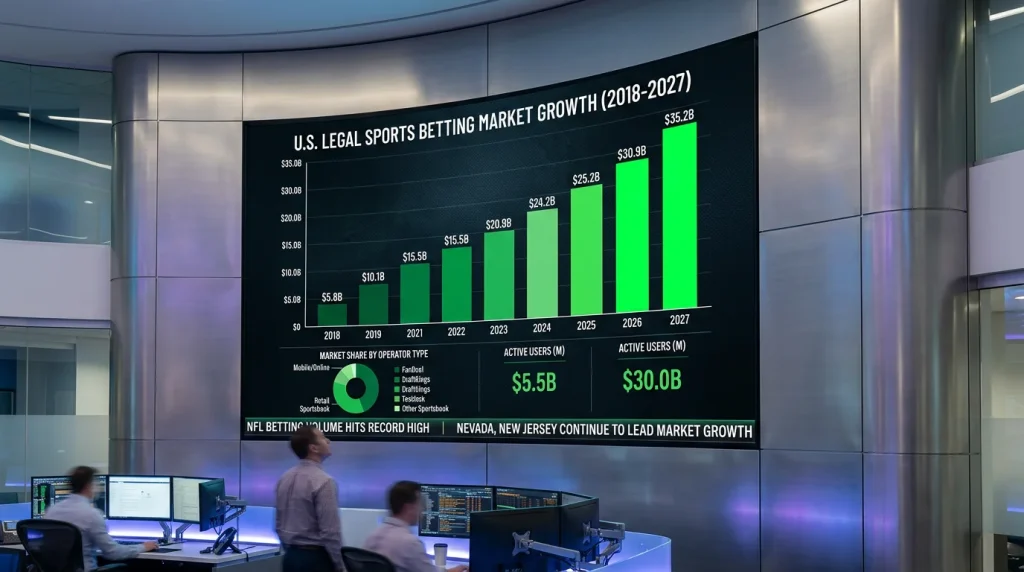
NFL Betting Handle: Global Expansion and UK Market Growth
When I started betting on the NFL from London in 2014, the market was small enough that you could feel its edges. Lines were soft. Player prop markets barely existed at UK sportsbooks. The total handle on a regular-season Sunday might not have moved a line by more than half a point all week. That world is gone.
The global sports betting market was valued at $111.9 billion in 2025, with projections reaching $226.2 billion by 2034 at a compound annual growth rate of 8.13%. Within that landscape, the American football betting market alone hit $8.52 billion in 2025 and is forecast to reach $9.5 billion in 2026 — a year-on-year growth rate of 11.5%, outpacing the broader sports betting market by a significant margin. By 2030, the projection is $14.49 billion. Those are not speculative numbers. They reflect a structural shift in how people engage with the NFL.
Global Market Size and Growth Projections
Europe accounts for 41.3% of the global sports betting market in 2025 — the largest regional share by a considerable margin. That dominance is driven by mature, regulated markets in the UK, Germany, Italy, and France, where online betting infrastructure has been established for over a decade. The online segment represents 67.5% of global sports betting activity, which means the vast majority of wagers are placed through the same digital platforms UK punters use every Sunday evening.
The American football share of this global market has been growing faster than any other major sport category, driven by two converging forces. On the supply side, the legalisation of sports betting across the United States since 2018 has created an enormous new market — more than $600 billion in cumulative legal wagers, with $165 billion in 2025 alone. On the demand side, the NFL’s deliberate global expansion strategy — 62 international games since 2007, with nine planned for 2026 across seven countries — is cultivating new audiences in every major betting market worldwide.
The growth is not linear. It compounds. More legal markets create more betting volume, which attracts more technology investment, which improves the product, which attracts more bettors, which justifies more legal markets. The flywheel is spinning, and American football is at its centre because the sport’s structure — weekly games, extensive statistics, a single championship event — is ideally suited to the mechanics of sports betting.
US Handle Data as a Growth Indicator
The estimated $30 billion in legal NFL wagers during the 2025 season represented an 8.5% increase over the revised 2024 figure of $27.5 billion. The Super Bowl alone is projected to attract $1.76 billion in legal wagers for its 2026 edition — a record. Bill Miller of the American Gaming Association has described these figures as evidence that no single event brings fans together like the Super Bowl, and that record betting volumes reflect how much Americans enjoy sports betting as part of the experience.
These US numbers matter for UK bettors for a reason that is not immediately obvious: they fund the analytical infrastructure that the entire global NFL betting market relies on. The sophisticated pricing models, real-time data feeds, injury tracking systems, and advanced statistical tools that UK sportsbooks use to set NFL lines are developed for and funded by the American market. As US handle grows, the investment in pricing technology grows with it, which means the lines UK punters face are getting sharper year on year.
The growth trajectory since 2018 is instructive. In the first full year after the Supreme Court overturned the federal ban on sports betting, total US sports handle was roughly $13 billion. Seven years later, it exceeds $165 billion annually. That tenfold increase has occurred even though not all US states have legalised sports betting — several large markets remain closed. When (not if) those remaining states legalise, the total handle will jump again, and the downstream effects on pricing sophistication and market depth will reach every sportsbook that offers NFL, including those licensed in the UK.
The UK’s Share of NFL Betting Revenue
The total GGY of the UK gambling industry reached 16.8 billion pounds in the financial year to March 2025, a 7.3% year-on-year increase. Remote betting — which includes all online sports wagering — contributed 2.6 billion pounds to that total. Football (the association variety) dominates UK remote betting GGY at 1.3 billion pounds, followed by horse racing at 766.7 million pounds. American football’s specific contribution is not broken out in the Gambling Commission’s data, but industry estimates place it in the tens of millions — a small but rapidly growing segment.
The UK online betting market generated $7,371.5 million in revenue in 2024, with online channels representing 78.47% of total activity. Within that market, the NFL occupies a niche that punches above its weight in terms of engagement intensity. NFL bettors tend to be more engaged than the average UK sports bettor — they research more, bet more frequently during the season, and explore a wider range of market types. This higher engagement per bettor offsets the smaller total audience relative to Premier League football.
The UK sports betting market is projected to reach $21.47 billion by 2030 at a compound annual growth rate of 11.4%. If American football’s share of that market grows even modestly — from, say, 2% to 4% of total sports betting GGY — the absolute volume of NFL wagering in the UK would more than double. That growth would be driven by the same factors fuelling it now: expanding UK audience, more international games in London, deeper market coverage at UK sportsbooks, and a younger demographic that is more comfortable with both American football and online betting.
For UK punters, the macro trend is clear: the market you are betting into is getting bigger, more competitive, and more efficiently priced every year. That does not mean edges disappear — it means the edges shift. Ten years ago, the edge was in spotting basic mispricings on lines that were set carelessly. Today, the edge is in analytical depth, timing, and the discipline to bet only when genuine value exists. The market rewards sophistication and punishes sloppiness more than it ever has. For how audience growth specifically drives this market expansion, the UK fan growth analysis covers the demographic and viewership data in detail.
How big is the global NFL betting market?
The American football betting market was valued at $8.52 billion in 2025, with projections reaching $14.49 billion by 2030. This sits within a broader global sports betting market of $111.9 billion growing toward $226.2 billion by 2034. The NFL drives more betting volume per game than any other major sports league, despite having fewer fixtures than the NBA, MLB, or Premier League.
What share of UK sports betting revenue comes from American football?
The UK Gambling Commission does not publish a specific breakout for American football betting revenue. Industry estimates place it in the tens of millions of pounds annually — a small but fast-growing segment of the 2.6 billion pounds in total UK remote betting GGY. The NFL"s share is growing as the UK audience expands, London games increase, and sportsbooks deepen their NFL market offerings to meet rising demand.
Articles
Written by the editors at American Football Betting Online.
